To collect phone numbers without losing subscribers, ask for the number after the email, in a separate step people can skip, with its own consent that names the store and the channel: WhatsApp, SMS or both. Then measure that step against the people who reached it, as well as against everyone who saw the form, and check every month how many new subscribers have also agreed to receive messages. In an Italian footwear store we work with, 63% of the people who leave their email in the pop-up also leave their WhatsApp number.
How do I collect customers' phone numbers for WhatsApp or SMS without lowering my signup rate?
With a multi-step form where each screen asks for one thing only. This is the structure used by the store in our case, which sells handmade women's shoes:
| Step | What it asks for | Why |
|---|---|---|
| 1. The yes | One click on "yes" (translated from Italian, like all the form copy quoted here), no fields | A small commitment that leads to the next field |
| 2. The email | Name and email, with one line on consent | It's the easiest contact to get and the one that counts as a signup |
| 3. The phone | WhatsApp number, its own consent, a link to skip | Anyone who doesn't want to share the number stays subscribed by email |
| 4. The confirmation | The promised gift and a button back to the store | It closes the journey and takes people back to browsing |
How to build the pop-up as a whole (when to show it, where, what to offer) is covered in our ecommerce signup pop-up article. Here we focus on the second contact: the phone number, its consent and how to measure it.
Why the phone number comes after the email
Klaviyo says so in its guide to multi-step forms: forms that collect email generally convert better than forms that collect phone numbers, and asking for both at once can slow down the growth of your email list. Its advice is email in the first step and phone in the second. Each step is saved as soon as it's submitted, so anyone who stops after the email is already subscribed.
In our case, over the last 30 days, from 10 September to 10 October 2026, 38,866 people saw the pop-up, 2,306 left their email and 1,455 also left their WhatsApp number: 63% of the people who had left their email.
A second store we work with, also in Italy, does the opposite: a side flyout that asks right away for the WhatsApp number only, with no email and no explicit gift. 1,673 people saw it and 42 left their number: 2.51%.
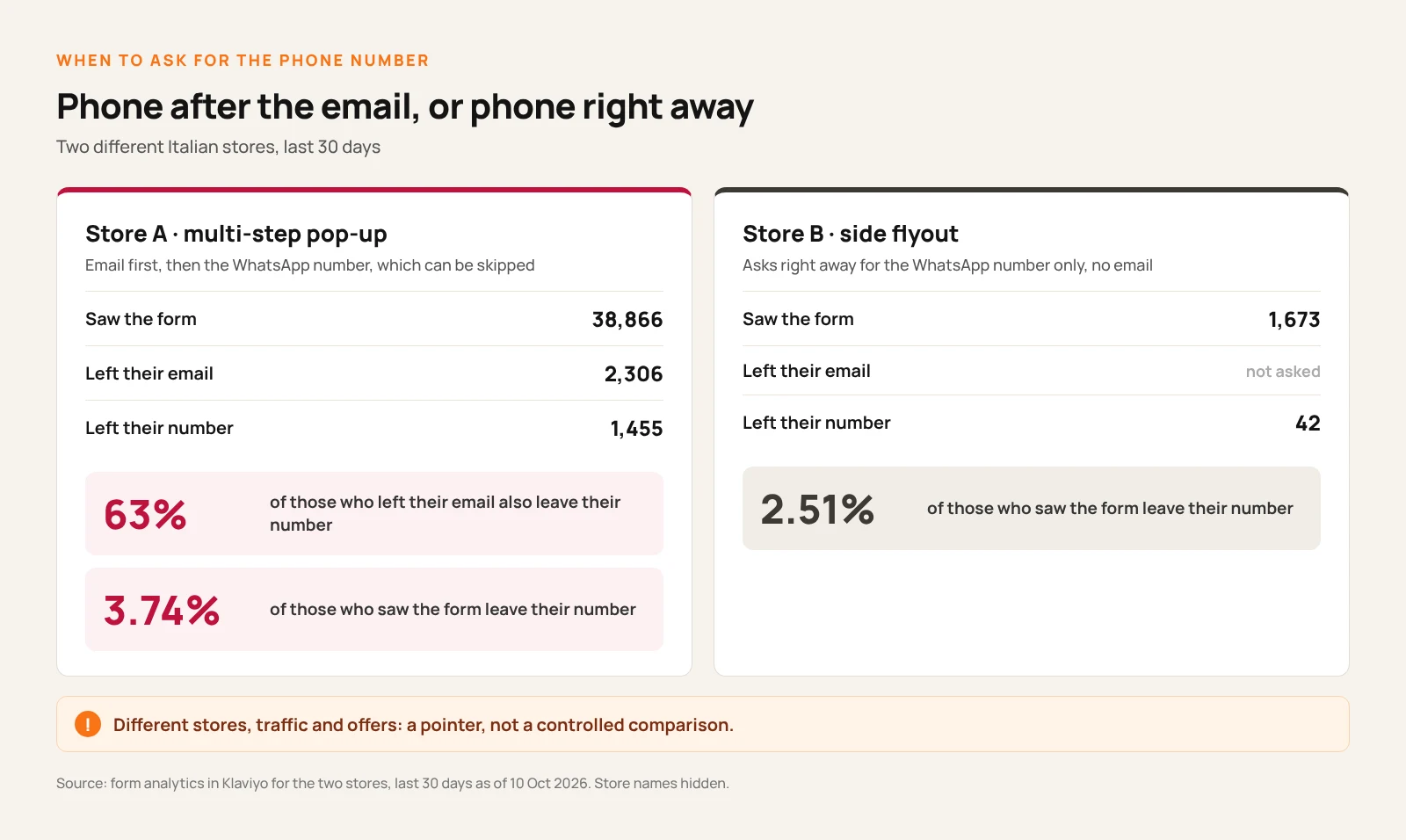
On the same basis, everyone who saw the form, the first store collects numbers from 3.74% of visitors, plus 2,306 emails. The stores, traffic and offers are different, so the comparison points in a direction rather than measuring an effect. That direction, though, matches Klaviyo's advice.
What to write in the phone step
The phone step needs its own consent. If you sell in the EU, the ePrivacy Directive allows marketing by electronic mail only with prior consent, and its recitals explicitly include SMS. Italy's data protection authority, where the store in our case operates, applies the same rule to WhatsApp and other messaging apps. Under the GDPR, consent must be specific and informed, and pre-ticked boxes don't count. A dedicated WhatsApp checkbox is the cleanest choice. Klaviyo adds that SMS consent doesn't count for WhatsApp: if you want to use both, name both.
If you text US numbers, check the TCPA rules: the FCC's definition of prior express written consent for automated telemarketing messages requires a clear disclosure and a statement that agreeing isn't a condition of purchase.
| What the text must say | Example | Who asks for it |
|---|---|---|
| The store's name | "I agree to receive WhatsApp messages from [store name]" | Meta, for WhatsApp opt-in |
| The channel, spelled out | WhatsApp, SMS or both | EU rules on prior consent; Klaviyo for the SMS and WhatsApp distinction |
| What messages will arrive | Offers and cart reminders | Meta recommends consent that covers the categories of messages you'll send |
| How to stop | "Reply STOP to stop receiving messages" | Meta recommends clear opt-out instructions; under the GDPR withdrawing must be as easy as giving consent |
| That it's optional | Unticked box; "not a condition of purchase" | GDPR (no pre-ticked boxes); FCC definition for the US; Klaviyo (must not look required) |
| Where to read more | Link to the privacy policy | GDPR (informed consent) |
Klaviyo suggests placing the consent text above the button, so people read it before tapping. Three practical details:
- The country code already set. A number without the international dialing code is often unusable. The store in our case presets the Italian one.
- A clearly visible skip link. The store's "No thanks, I'm not interested" should be as easy to see as the button. A hidden link or a guilt-tripping line is a bad practice, and it brings in numbers collected the wrong way.
- Consent before the cart is abandoned. A WhatsApp cart reminder can only go to people who have already given consent. The full rules are in abandoned cart text messages: SMS and WhatsApp.
How to read a multi-step form: two percentages
Every step has two percentages, and Klaviyo shows both. Engagement is calculated against all views of the form. Drop-off is calculated against the previous step.
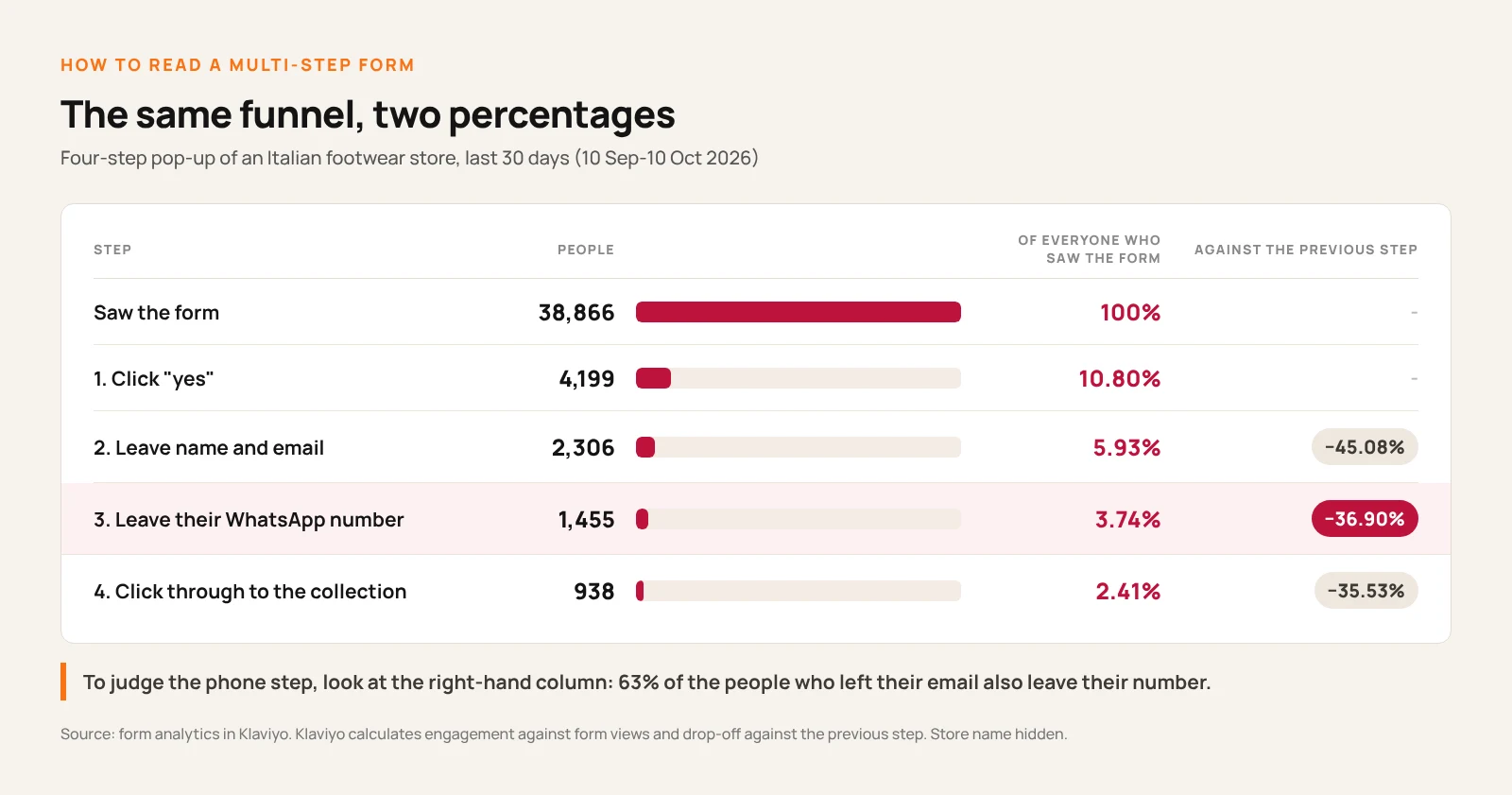
For the phone step, the second reading is the one that counts. The 3.74% of everyone who saw the form also depends on steps 1 and 2: if the first step brings in more people tomorrow, that number goes up even if the phone step stays exactly the same. The 36.90% drop between email and phone, meaning the 63% who carry on, measures that step alone.
Two more things to know before comparing numbers:
- What counts as a signup. When a form asks for email and phone in different steps, Klaviyo counts whichever of the two fields comes first as the submit. Here it's the email: 2,306 signups, 5.93% of the people who saw the pop-up.
- The rate's denominator. The current version of the pop-up, live since 23 July 2026, has a signup rate of 5.97% on total views and 9.75% on unique visitors, because the same person can see it more than once. Klaviyo uses total views in the overview and unique visitors in A/B tests: only compare numbers with the same denominator.
Beyond the funnel: the list month by month
The funnel tells you what happens in the pop-up. The list tells you how many people you can actually contact. As of 10 October 2026 the store has 29,013 profiles in its newsletter list and 6,006 in its WhatsApp and SMS list. Comparing them directly is misleading: the newsletter has existed since 2022, the WhatsApp list since August 2025. Look at new entries instead: from November 2025 to 10 October 2026 there were 9,103 in the newsletter list and 5,910 in the WhatsApp list.
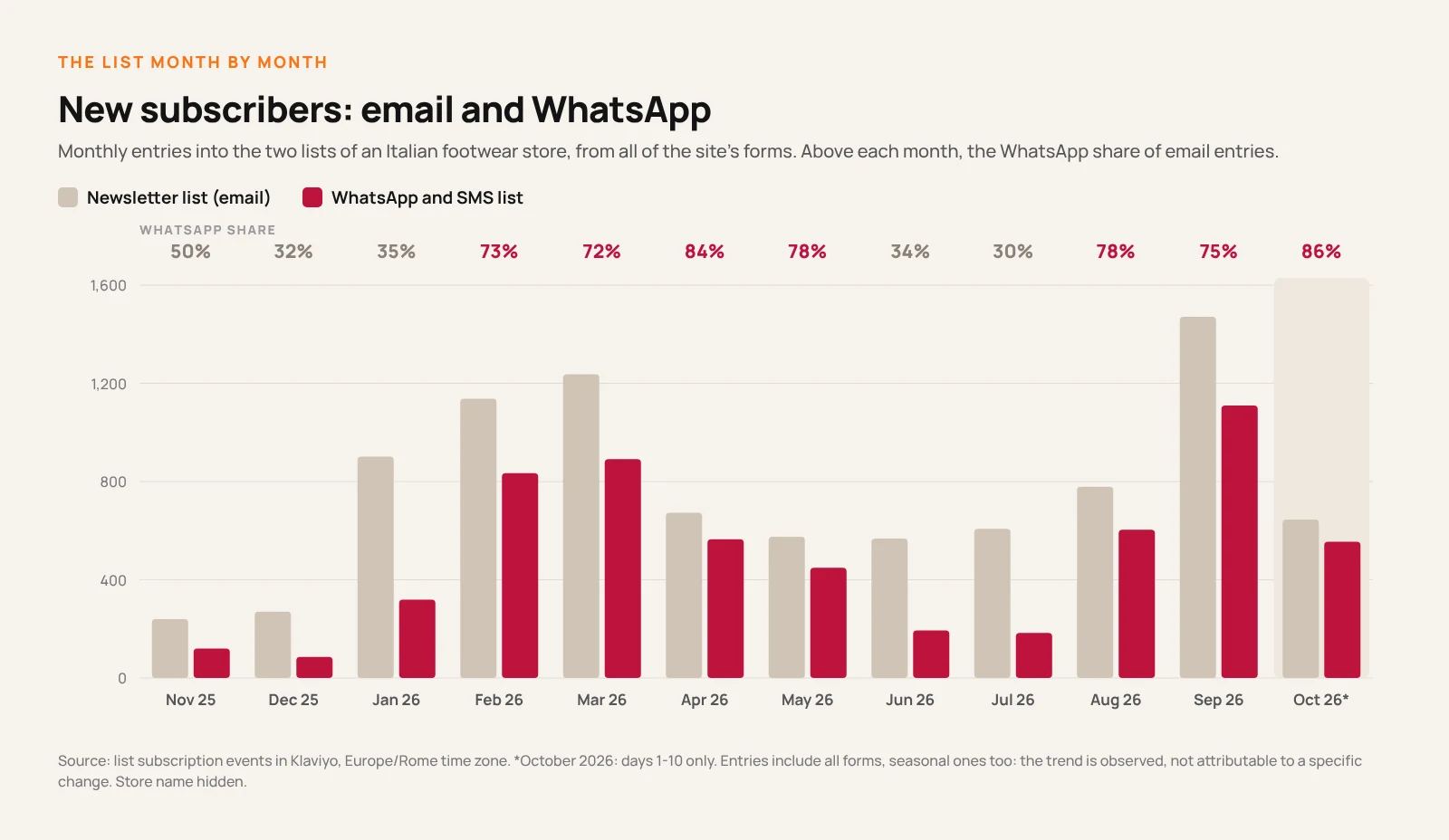
Since August, about 3 in 4 new email subscribers have also joined the WhatsApp list; in June and July it was about 1 in 3. We don't attribute the change to any specific edit. The share was also high from February to May and low in December and January. Entries include all of the store's forms, seasonal pop-ups included. And the structure of earlier pop-up versions can't be verified. It's an observed trend, to keep an eye on every month.
The funnel's 63% and the lists' "3 in 4" don't match because they count different things:
| Measure | Value in our case | What it counts |
|---|---|---|
| Phone step against email step, in the pop-up | 63% (1,455 out of 2,306), last 30 days | People who leave their number after the email, in that pop-up only |
| WhatsApp list entries against newsletter list entries | About 3 in 4 since August (75% in September) | All of the store's forms, month by month |
| Recorded messaging consents against WhatsApp list entries | 4,541 out of 5,910, since November 2025 | The people you can actually message |
The last row is the one most often missed. Not everyone who joins the WhatsApp list shows a recorded consent to messages: about 3 in 4 do. The data doesn't say why, and it's the first thing to check. A number without recorded consent won't get the cart reminder.
How to test one step at a time
The store in our case has published nine versions of the pop-up since August 2025, without a formal A/B test. That's why we can describe the trend but can't say which change worked. A well-run test avoids the problem.
- Change one step at a time. If you change the "yes" copy and the phone copy together, you won't know which one moved the result.
- Judge each step against the previous one. That way a stronger first step doesn't make the second look better too.
- Combine the best steps. An example with made-up numbers. In variant A, 12% click yes and 6% leave their email: half of those who clicked. In variant B, 9% click yes and 5.4% leave their email: 60%. A wins overall, but B's email step holds up better. The next test pairs A's first step with B's second.
- Test it, don't assume it. People who come in through a more inviting first step may be less motivated. The combination needs to be tested.
- Watch the volumes. A difference of a few dozen signups can be chance: let the test run until the numbers settle.
People who skipped the phone step
Someone who said no to the number isn't lost: they're subscribed to your emails. You can ask again later, when they have a reason to say yes. For example in an email from the welcome series that explains what you send on WhatsApp and what you don't (see our ecommerce welcome email series). Or with a form shown only to subscribers who haven't given their number yet. Always with its own consent, and without showing it on every visit.