An ecommerce welcome series usually has five to seven emails over two to three weeks: the first goes out right away and delivers what the form promised, the others build trust, and a branch reminds only the people who haven't used the code. The first email is the one to work on most: in the footwear store we work with, it drives 108 of the 168 orders attributed to the series in a year. Below you'll find that store's sequence, the numbers email by email, what we learned from them and what we would change.
What should an ecommerce welcome series include, and how many emails should you send?
Each email has a single job, and the order matters:
- The welcome with the promised gift, right away: the code, if the form promised one, and a few well-chosen products.
- Trust: who's behind the store, real reviews, shipping and returns explained.
- Help choosing: a practical guide, common mistakes, a size chart.
- The code reminder, only to people who haven't used it.
- One or two relationship emails: customer stories, product facts, an invitation to ask for advice.
On the number, the data from the case is clear: the first emails do the work, the last ones much less. If an email doesn't give something useful, drop it.
Why the welcome series outperforms newsletters
Someone who just subscribed has just told you "I'm interested"; a few weeks from now, they'll read your newsletters like everyone else. In Omnisend's benchmarks on 2025 email data, welcome automations convert at 2.11%, against 0.08% for campaigns. Klaviyo's 2026 report puts the average click rate for welcome emails at 6.5%, rising to 13.3% for the top performers.
The Omnisend report also flags a risk: welcome emails have one of the highest unsubscribe rates among automations, at 0.87%. People who sign up only for the code and get nothing but requests to buy leave quickly. In the case we look at below, the average for the series is 0.83%.
The case: a footwear store's welcome flow
The store sells premium women's footwear. Subscribers come from a pop-up with a €15 code on the first purchase, and joining the list triggers the flow. There are seven emails, one every three days at 6:30 p.m., for about 18 days in total.
| When | Content | Who gets it | |
|---|---|---|---|
| 1 | Right away | The gift: the first-purchase discount, with the subscriber's name in the subject line | Everyone |
| 2 | 3 days later | The brand story | Everyone |
| 3 | 3 days later | Practical guide: how to choose the right style, in three tips | Everyone |
| 4 | 3 days later | Discount reminder | Only people who haven't bought with the welcome code yet |
| 5 | 3 days later | The story of a loyal customer | Everyone |
| 6 | 3 days later | "Did you know…": a product fact | Everyone |
| 7 | 3 days later | Reviews and testimonials | Everyone |
Before email 4 the flow splits. There's only one question: has this person already bought using the welcome code? If not, they get the reminder and then carry on. If so, they skip the reminder and go straight to email 5.
The numbers, email by email
Data from the last 12 months, read from the store's account.
| Recipients | Clicks | Attributed orders | Revenue per recipient | Unsubscribes | |
|---|---|---|---|---|---|
| 1. The gift | 7,384 | 9.4% | 108 | €2.96 | 0.46% |
| 2. The story | 6,962 | 3.8% | 22 | €0.61 | 1.01% |
| 3. The guide | 6,817 | 4.0% | 9 | €0.26 | 0.87% |
| 4. Discount reminder | 6,132 | 5.0% | 10 | €0.32 | 0.51% |
| 5. The loyal customer | 6,470 | 2.8% | 7 | €0.21 | 0.86% |
| 6. Did you know | 6,151 | 2.0% | 9 | €0.29 | 1.11% |
| 7. The reviews | 6,018 | 2.2% | 3 | €0.10 | 1.05% |
In total the series drove 168 attributed orders and €33,071 in revenue, with an average order value of around €197. The average click rate is 4.3%, spam complaints 0.04%.
What the numbers say
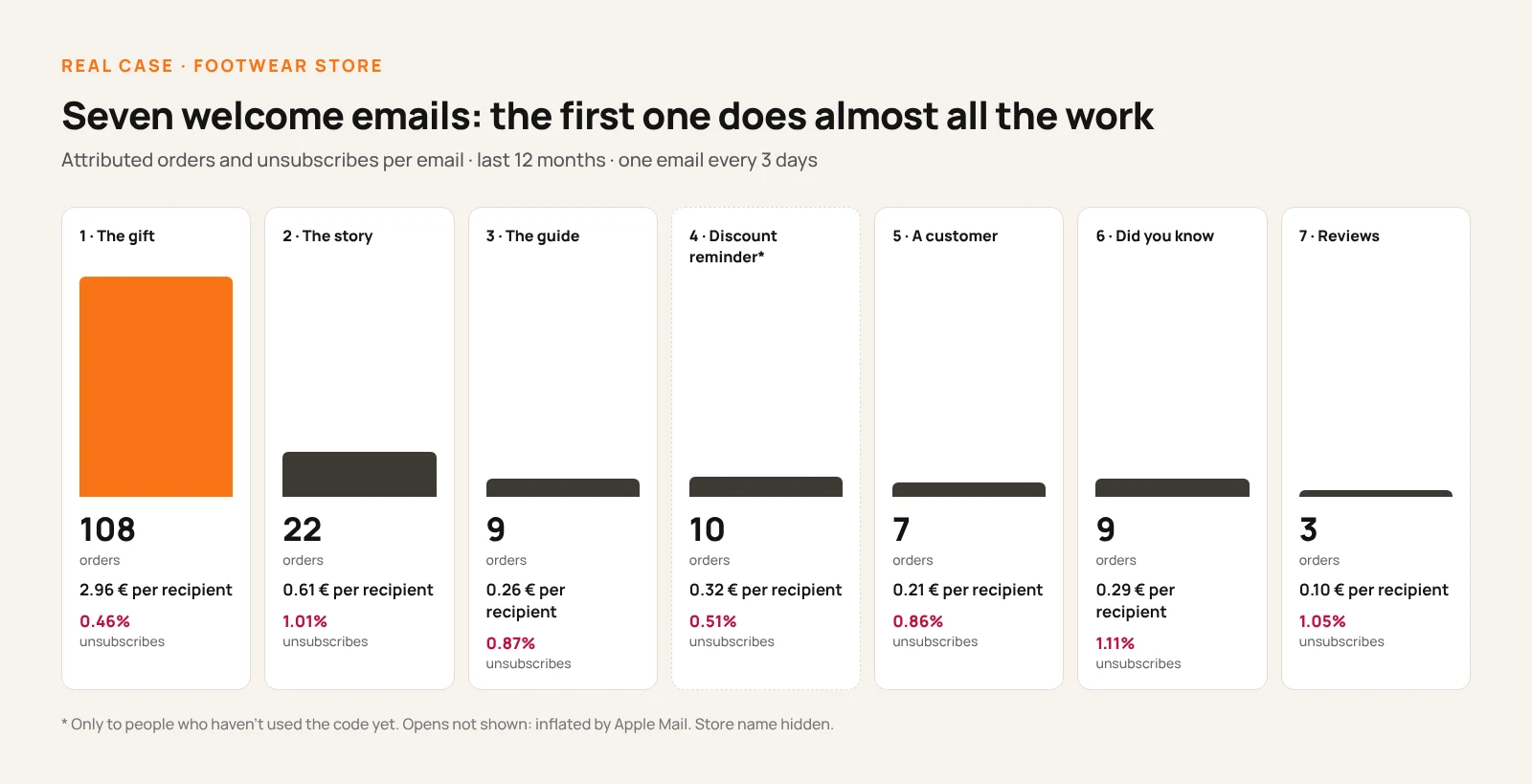
The first email does almost all the work. It drives 64% of the orders and about 65% of the series' revenue. It's the email people are waiting for, because it holds the gift they were just promised: it has to arrive right away, deliver the gift clearly and show only a few products. If you have time to improve just one email, make it this one.
From the second email on, unsubscribes double. They go from 0.46% on the first to about 1% per email, while orders collapse. Emails 5, 6 and 7 together drive 19 orders. Doing the math on recipients, over the same period they collected about 190 unsubscribes. Not all of those are a loss, because some of those people would have left anyway. The signal is clear, though: the last emails ask for attention and give little back.
The reminder works because it's targeted. It only reaches people who haven't used the code and has the highest click rate after the first email (5.0%), with fewer unsubscribes than the emails around it (0.51%): it talks about something the recipient cares about and doesn't bother people who have already used the code.
Opens don't count. They sit between 45% and 50% almost everywhere, inflated by Apple Mail's privacy protection: Klaviyo itself says it can't tell a real open from an automatic one. The differences show up in clicks, orders and unsubscribes.
Attributed doesn't mean caused. With its default settings, Klaviyo attributes an order to the last email opened or clicked in the previous 5 days. Some of those 168 orders would have come in without the email: the number is for comparing emails with each other, not for saying how much the store would have lost without the series.
The "has already used the code?" branch
Splitting customers and non-customers into two sequences means people who've already bought miss the information the store considers important. The case uses a single flow with a branch, and that's the approach we recommend:
- The code reminder only goes to people who haven't used it. This is consistent with the rule of not giving discounts to people who've already bought, as explained in the article on discounts in abandoned cart emails.
- Everything else goes to everyone: the story, the guide and the reviews are useful to people who've already ordered too.
- The condition can be widened. The store checks whether the code was used; you can also have people who ordered without it skip the reminder, and show existing customers a block on caring for what they bought.
The reminder doesn't repeat email 1. It ties the code to something new, such as the styles from the guide they just read. And if it mentions an expiry date, that date has to exist. A code that's "about to expire" and stays valid for months teaches your list not to believe you.
While the sequence is running, keep new subscribers out of your regular newsletters: two emails on the same day are confusing and push unsubscribes up.
How many emails and how often: the case and the general advice
The usual advice is to concentrate the first emails in the first few days and wrap up the series in about two weeks. An agency quoted by Klaviyo has found that most people buy within about ten days of subscribing, and Klaviyo recommends matching the sequence to your audience's buying cycle.
The store in our case does it differently: one email every three days, for 18 days, with the reminder on day nine. Its data doesn't contradict the general advice, but it doesn't prove it either: a tighter rhythm was never tested here. It does show where to look, though. Almost everything happens in the first email, and from the second on, each email collects more unsubscribes than the orders it drives.
For this store we would test two things, one at a time:
- Shorten the series. Drop or merge emails 6 and 7, and compare orders and unsubscribes with the current version.
- Send the reminder earlier. Before day nine, right after the guide, while the code is still fresh.
These are hypotheses to test. A product that costs a few euros and shoes at almost €200 have different decision times: one store's data is a case, not a rule.
Before the welcome: the confirmation email
If you use double opt-in, the first email a subscriber gets is the confirmation request, and people who don't confirm never make it onto the list. Send it right away, with one button and no products, and say what happens if they don't confirm: "Your first-order code arrives as soon as you confirm." Send one reminder a couple of days later at most; anyone who still doesn't confirm stays off the list. The page that opens after confirmation is a good place for the code: the person is already on your site.
In the US, CAN-SPAM is an opt-out law: it doesn't require consent before you send marketing emails. Double opt-in is a choice you make for list quality, and if you sell in the EU it's also a practical way to document consent.
Making the last emails more useful
Emails 5, 6 and 7 in the case are the same for everyone. To make them more relevant, use what the subscriber has told you or done.
A question in the form. This is what's called zero-party data: information customers give you voluntarily. For a footwear store it could be "What occasion are you shopping for?", with three answers: everyday, work, special occasion. With that answer, the first email, the guide and the reminder show the right styles; people who don't answer get the general version.
Behavior during the series. People who clicked the guide without buying can get the styles it talked about; people who haven't clicked anything in two weeks can leave the flow early.
The same answers also work for Meta audiences, as explained in the article on email and Meta Ads.
A welcome series without a discount: yes, you can
The code isn't mandatory. For a store with tight margins, or with customers who buy on expertise more than on price, the sequence works without one.
Instead of the code, you need a different promise in the form: a buying guide, early access to collections, one-to-one advice by email or WhatsApp, shipping and returns explained precisely. The case shows how much the first email weighs when it delivers a gift: without a discount it has to deliver something just as concrete, and the reminder becomes a recommendation of the best-suited products.
What to measure
Three checks, email by email, once a month:
- Orders and revenue per recipient: which emails drive the first purchase. Revenue per recipient also lets you compare emails with different audiences, like the reminder.
- Unsubscribes: if they spike at a specific point, that email asks too much or arrives too early. In the case, the jump is between the first and the second.
- Code usage: how many subscribers use it, and how many buy without it.
If your welcome emails often land in spam, the problem comes earlier: we cover it in the article on deliverability.
The most common mistakes
- A single welcome email. Anyone who doesn't buy right away hears nothing more until the next newsletter.
- Neglecting the first email. In the case it drives almost two orders out of three: a poorly delivered gift weighs more than any email that follows.
- Sending the code to people who've already bought. It teaches customers to wait for a discount they shouldn't get.
- Making the series longer out of habit. Every extra email has to bring something: if it only brings unsubscribes, drop it or change it.
The welcome series is one piece of a broader strategy, alongside campaigns, cart recovery and post-purchase emails. The full picture is in the article on ecommerce email marketing strategy.