Your email list and Meta Ads help each other in two directions: list segments become audiences for retargeting, exclusions and lookalike audiences, while lead ads bring new subscribers straight into your list. It works if you send Meta a few segments with a clear purpose, write your ads with what your cart recovery emails have already learned, and upload only contacts you have a legal basis for. We'll also look at the data of a footwear store we work with.
How do I use my email list for Meta campaigns, and the other way round?
There are two directions, and it pays to keep them separate.
- From the list to Meta. A segment in your email platform (customers, subscribers with no orders, the waitlist) is synced as a custom audience. You use it to show ads to those people, to exclude them from a campaign or as a seed for finding similar people.
- From Meta to the list. A lead ad with an instant form collects email addresses and consent inside Facebook or Instagram. If the form is connected to your email platform, the contact joins the list right away and the welcome flow starts.
Klaviyo, to take one example, offers both through a native integration, and almost every email platform has something similar. On Google Ads the feature is called Customer Match, with its own rules on consent for users in Europe.
From the list to Meta: how it works
When you upload a list, email addresses and phone numbers are hashed before they're used. Meta compares this data with its users' data and builds the audience from the people it can match.
Three things to know before you start:
- The audience will be smaller than the segment. Only people with a profile linked to that email address or phone number get matched. The more identifiers you provide (phone with country code, first name, last name, country), the more people are recognized.
- There's a minimum size. Klaviyo states that Meta requires at least 100 profiles to create a custom audience, and Meta gives the same minimum for using an audience as the source of a lookalike audience.
- Updates aren't instant. With the Klaviyo integration, segments sync every hour, but Meta can take 24 to 48 hours to update the audience. For behavior from a few hours ago, a pixel-based website audience is faster. Lists work better for groups that change slowly.
Which segments to send to Meta, and what to do with them
Each segment needs a specific use, or you end up with a pile of audiences nobody touches.
| Segment | Use on Meta | Practical notes |
|---|---|---|
| All customers, or recent buyers | Exclusion from new-customer campaigns | You stop paying to show a welcome offer to people who already bought |
| Best customers (highest spend or most orders in the last year) | Source for a lookalike audience | Meta itself suggests starting from your best customers rather than all of them |
| Potential buyers: recently active, no orders | Retargeting toward a first purchase | They know the brand: they need social proof and clear shipping and returns information |
| Abandoned carts from the last 7-14 days | Retargeting coordinated with recovery emails | Only contacts with marketing consent. A window of days, not hours |
| Unengaged by email for 3 months or more | Reach them on Meta instead of pushing more emails | If they don't respond there either, exclude them from both channels |
| Promotion waitlist | Early access, exclusion from lead ads | People already signed up shouldn't see the invitation to sign up |
One more segment worth building: people who got your abandoned cart emails and didn't buy. That's a sharper audience than "all site visitors". They picked a product, left their email and already got a reminder.
The case: a footwear store's four segments
A footwear store we work with sells premium handmade women's shoes, on Shopify with Klaviyo. These are its four segments built for Meta, read from the account.
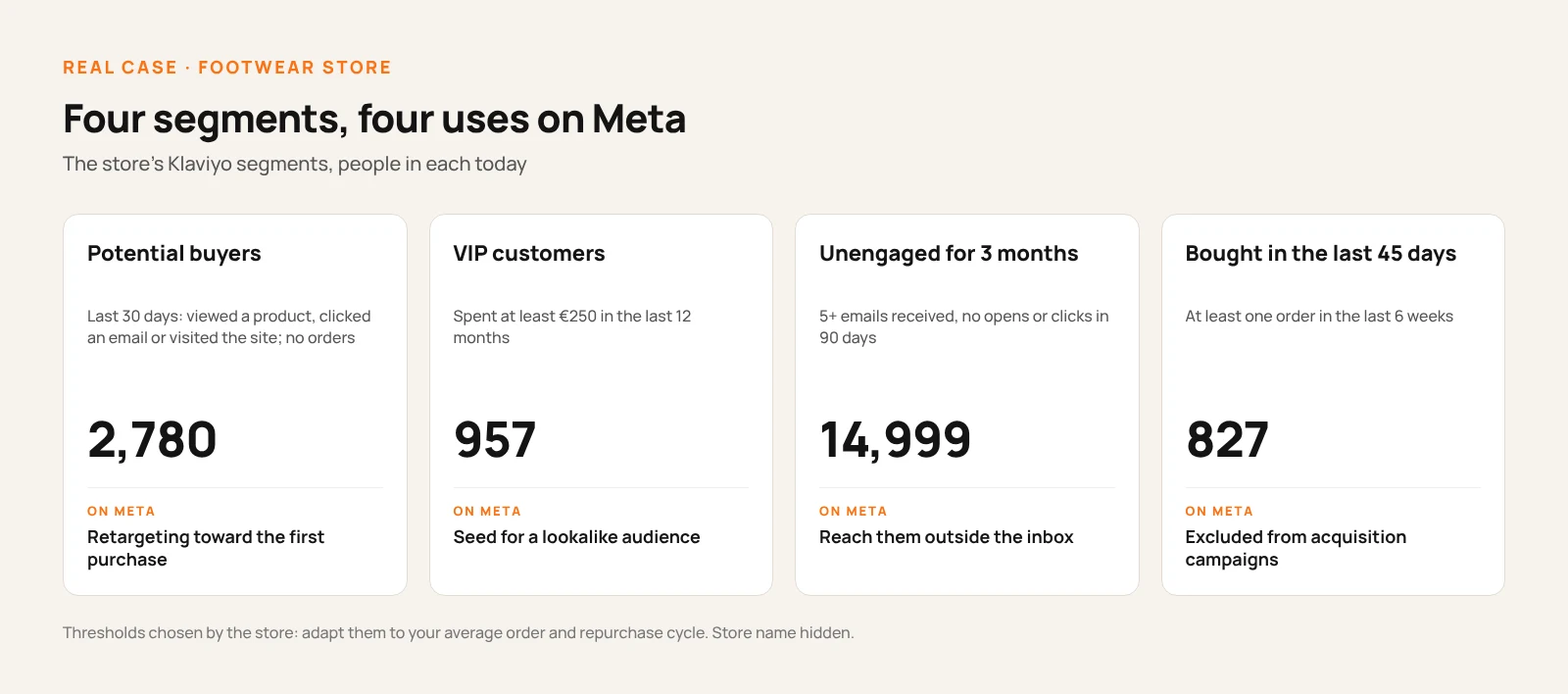
- Potential buyers, 2,780 people. In the last 30 days they viewed a product, clicked an email or visited the site, have never ordered and can receive marketing emails. This is the warm audience for retargeting, and a 30-day window easily absorbs Meta's update times.
- VIP customers, 957 people. They spent at least €250 in the last 365 days. They're the seed for the lookalike audience: even if Meta matches only part of them, they stay above the 100 minimum.
- Unengaged for 3 months, 14,999 people. On the list for at least 90 days, at least 5 emails received, no opens and no clicks in the last 90. Writing again and again to people who don't open hurts your sender reputation, as we explain in why emails go to spam: on Meta you reach them without touching your email sending.
- Bought in the last 45 days, 827 people. Excluded from new-customer campaigns.
Two caveats. The thresholds (€250, 45 days, 5 emails) are this store's choices, set around its average order value and repurchase cycle: adapt them to yours. And the unengaged count is an underestimate. Apple Mail Privacy Protection preloads email images, so the platform records opens nobody made; Klaviyo itself says it can't tell them apart from real ones. Apple Mail users can look active and stay out of the segment. When you can, give clicks more weight.
Keeping email and ad messages consistent
When the same people get your emails and see your ads, both channels need to say the same thing.
- Same offer, same deadlines. If the newsletter announces 20% off through Sunday, the ad aimed at subscribers reminds them of 20% off through Sunday. A different discount on Meta teaches people to wait for the better offer.
- The ad points back to the email. A line like "We emailed you this morning: your code is in your inbox" works with people who didn't open, and sends them to the email instead of replacing it.
- Cart recovery rules apply on Meta too. The emails go out at 1 hour, 24 hours and 48-72 hours, and the first one has no discount. An ad with a code shown to someone who abandoned half an hour ago undoes that logic. The full reasoning is in our guides on when to send abandoned cart emails and on discounts in abandoned cart emails.
- Buyers leave everything. A purchase removes the contact from retargeting and moves them into post-purchase, in both emails and ads.
Which segments exist and what they receive comes from your overall plan, described in our ecommerce email marketing strategy.
Your recovery emails already know what to write in your ads
Keeping channels consistent tells you when to speak and with which offer. What to lead with comes from your cart recovery emails: they're an ongoing test on people close to buying. Each message leans on one angle (novelty, social proof, urgency, discount) and the orders that follow show which angles work for that store.
In the footwear store, 29,124 recovery emails went out in the last 90 days, with 138 attributed orders and an average order value of €265. The chart combines the full history, angle by angle.
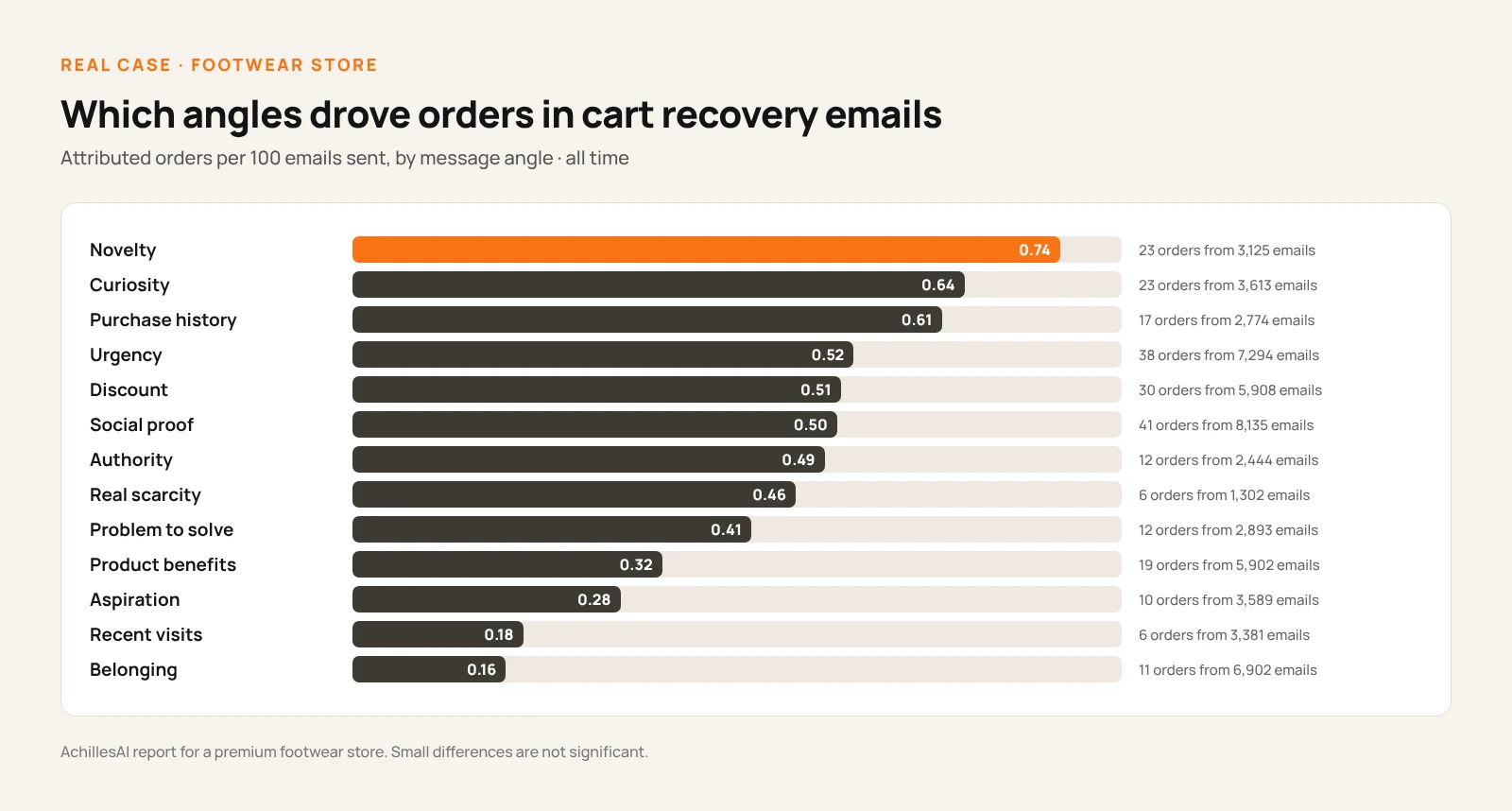
Read from a premium brand's point of view, it says four things:
- Novelty has the highest rate. 23 orders from 3,125 emails, or 0.74%: the best among angles with a large sample. "The style you haven't seen yet" works better than "did you like this one?".
- Discounts don't sell better than other angles. They sit at 0.51%, level with urgency (0.52%) and social proof (0.50%). For a premium brand, a discount costs margin and lowers perceived value: in your ads it shouldn't be the main message.
- Medium-length copy beats long copy. Emails of 35-60 words have a rate of 1.3% across 11,271 sends, those of 80-120 words 1.0% across 6,843.
- Urgency works when it's real and elegant. Handmade shoes in limited quantities are a real reason not to wait, and you can say so with grace. "OFFER ENDS IN 2 HOURS" clashes with the brand.
Two words of caution. Below 100 sends, a number is a hint, not a finding: the report shows scarcity on the cart page at 20% on 5 sends and social proof at checkout at 7.41% on 27, numbers that a single order more or less turns upside down. And people who get a recovery email have already picked a product, while ads also reach colder people: the brief applies right away to retargeting potential buyers, but for lookalike audiences it has to be tested.
From the report to the ad brief
The angles that drove orders become copy in four beats:
- Hook: what makes the product unique, called by the name of the style.
- Value: materials and craft, in one or two sentences.
- Real limited availability, never manufactured.
- A non-transactional call to action: "Find your pair" instead of "Buy now".
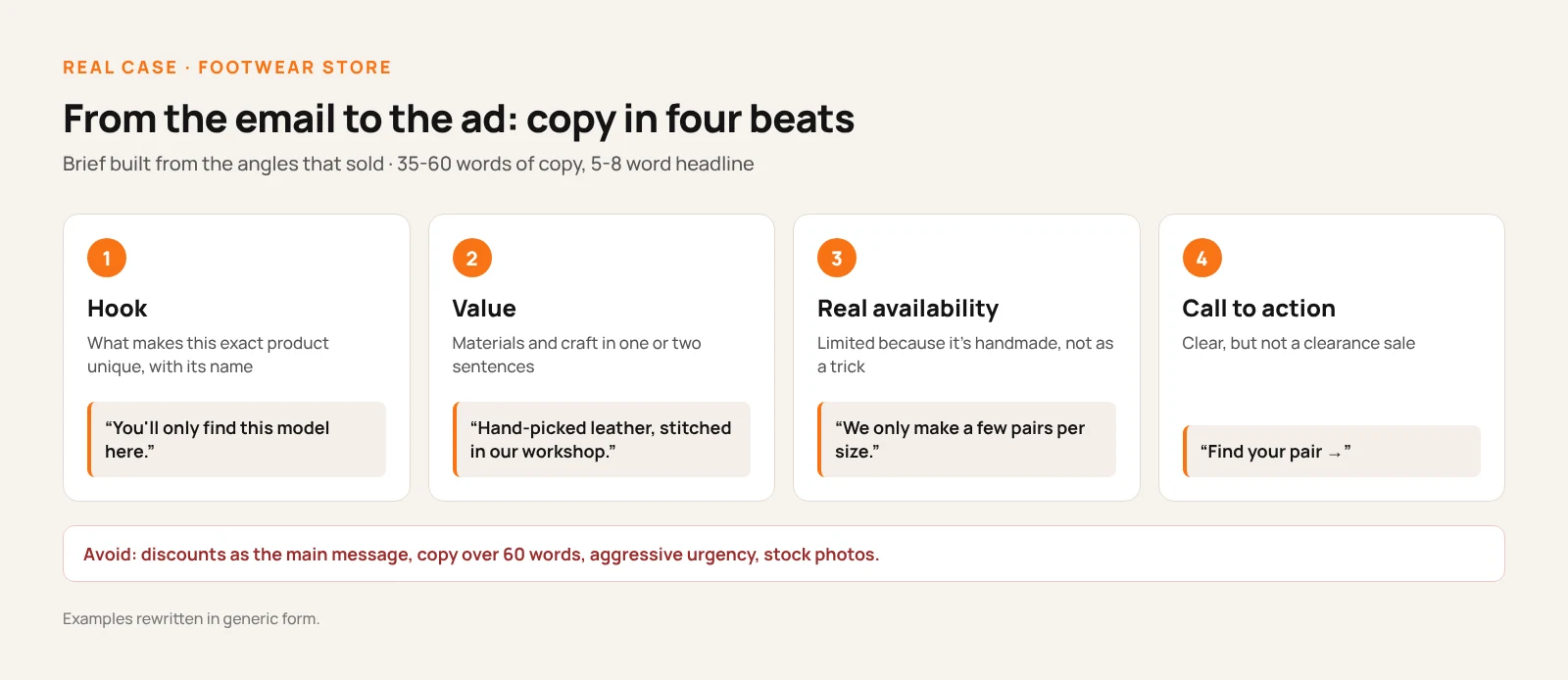
Copy between 35 and 60 words, headline between 5 and 8. Avoid: discounts as the main message, long copy, a generic tone, stock photos, aggressive urgency. For formats: a carousel showing the details of the craft for real scarcity, a short "discovery" video for novelty, and genuine reviews with name and city, published with the writer's permission, for social proof.
How much data you need before relying on Meta's optimization
According to Meta, an ad set exits the learning phase once its delivery stabilizes, usually after about 50 results in the week after the last significant edit. If it's unlikely to get there, Meta flags it as learning limited. For a premium store with a few orders a week, that's a high bar. Start with a test budget, combine similar ad sets and grow the conversion events you track before relying on purchase optimization and lookalike audiences.
From Meta to the list: lead ads connected to your email platform
Lead ads with an instant form show a form prefilled with profile data: interested people confirm in two taps without leaving Facebook or Instagram. Meta lists newsletter sign-ups among their uses. They do on Meta the job your signup pop-up does on your site.
The value is in the connection. With the Klaviyo integration, for example, contacts reach the list in real time and the welcome email goes out right away. The connection only covers future sign-ups: leads collected before need to be exported and imported.
What the form needs:
- A link to your privacy policy, which Meta requires in lead ads.
- A dedicated checkbox for marketing emails, with clear wording on what the person will receive. Meta lets you add custom consent checkboxes. If you sell in the EU, this is what makes the consent hold up. In the US, the CAN-SPAM Act doesn't require prior consent for marketing emails, only a working opt-out, but a clear checkbox still shows exactly what people signed up for.
- A specific promise, like "24-hour early access to the sale", instead of a generic "sign up for our newsletter".
The best use case is a waitlist ahead of a promotion, described in our Black Friday email plan. Exclude people already on your list from lead ads: paying to sign up someone who's already subscribed is the easiest way to waste budget.
Privacy: what to check before uploading a list
This isn't legal advice: these are points to check with whoever handles privacy for your store. If you sell in the EU, the GDPR and the European guidelines below apply. Outside the EU, local laws apply, along with Meta's terms, which apply everywhere.
- Legal basis and privacy notice. Meta's terms for customer list custom audiences require whoever uploads the list to have the permissions and a legal basis to do so. The European guidelines on targeting social media users (EDPB 8/2020) give the example of a customer who was told at the time of collection that their email could be used for social media advertising, and was free to object: in that case legitimate interest can hold. For someone who never became a customer and was never informed, the same example says no.
- People who object come off. Meta's terms ask you not to include anyone who has opted out, and to remove them if they object later.
- No sensitive data. Meta prohibits audiences based on health information, even when it's implied. A supplement store can't create or upload a segment called "customers with sleep problems".
- Handle abandoned carts and unengaged contacts with care. Someone who left their email at checkout without subscribing isn't automatically a contact you can upload, and staying on the list isn't enough if your privacy notice doesn't cover social media advertising. Filter your segments to contacts with marketing consent.
The most common mistakes
- Uploading the whole list as one audience. It includes contacts that shouldn't be uploaded, and it has no purpose.
- Not excluding customers. The welcome offer ends up in front of people who already bought.
- Different offers in emails and ads. People who get two different discounts wait for the next one.
- A discount at the center of every ad. In the case above it doesn't sell better than novelty, real urgency or social proof, and for a premium brand it costs margin and perceived value.
- Deciding on small samples. An angle at 20% on 5 sends isn't a discovery.
- Segments with windows of a few hours. Given Meta's update times, an "abandoned cart in the last hour" audience is always behind.