Market research that's useful to an online store answers six questions: what customers want, what holds them back, what makes them decide, how the category talks, how they describe themselves and what to do in the next 30-60 days. There are three sources, and you already have them or can get them for free: your product reviews, your competitors' websites and Google searches with their month-by-month volumes. We'll walk through it with the report of a footwear store we work with.
How do I do market research for my online store?
You don't need a research agency or a survey to send to customers. You need to read three things that already exist, with a method.
| Source | What it tells you | Its limit |
|---|---|---|
| Your product reviews | What convinced buyers, the doubts they had beforehand, the words they use | Only buyers speak: people who stopped earlier aren't there |
| Websites of direct competitors and benchmark brands | How the category talks, what others promise, what nobody says | They're promises, not proof: they tell you what they sell, not what works |
| Google searches | What people look for, how much and in which month, with the exact questions | Volume tells you interest, not the intention to buy from you |
The most useful reviews are the 3- and 4-star ones. People who give 5 stars often write "gorgeous". People who give 3 explain what they expected and didn't get. From competitors, take the register, never the sentences: copying a claim makes you just like them.
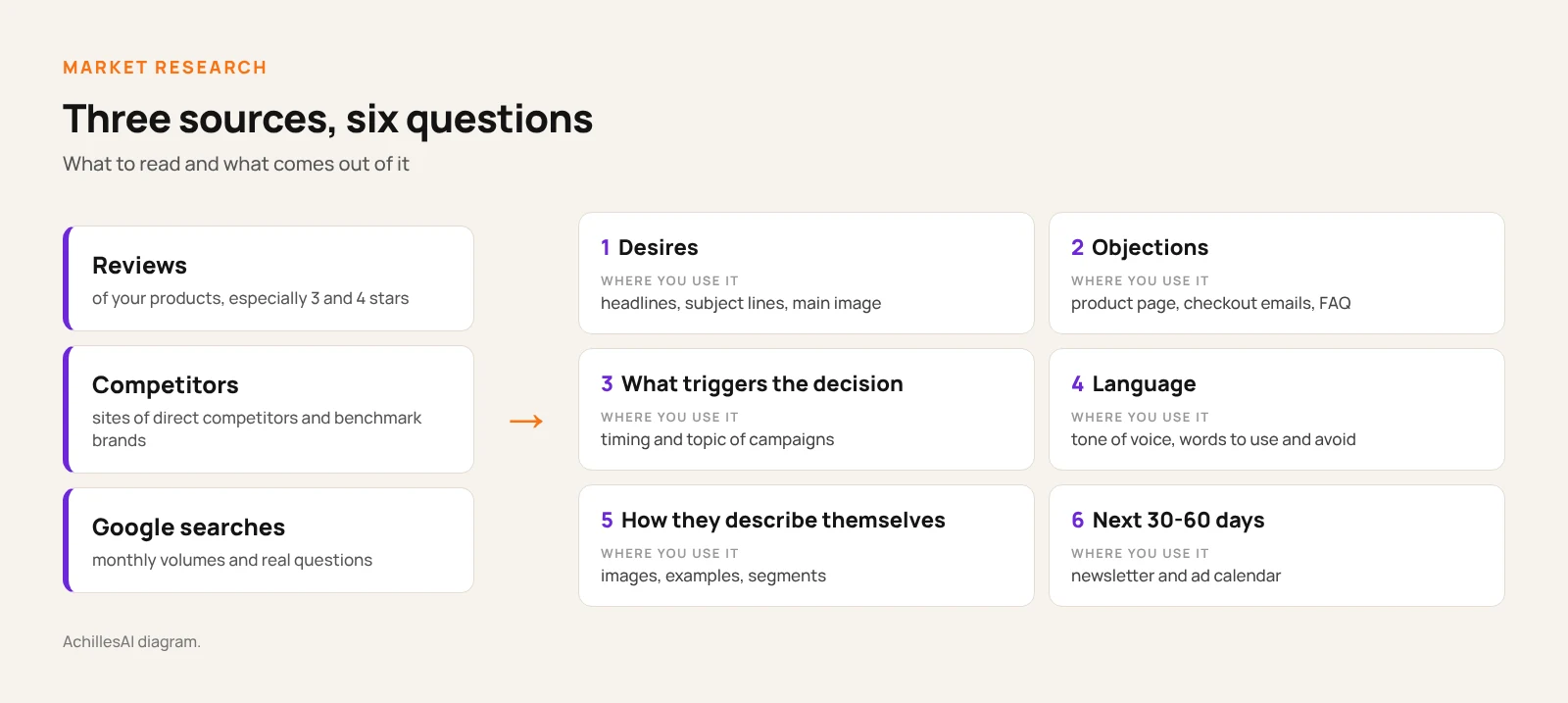
The six questions it has to answer
Each answer has to end up somewhere specific, or it stays a document nobody rereads.
| Question | Where you find the answer | Where you use it |
|---|---|---|
| What they really want | Positive reviews, questions on Google | Headlines, email subject lines, main image |
| What holds them back before buying | 3-4 star reviews, pre-purchase questions | Product page, checkout recovery email, FAQ |
| What triggers the decision | Reviews, search seasonality | Timing and topic of campaigns |
| How the category talks | Websites of competitors and benchmark brands | Tone of voice, words to use and words to avoid |
| How customers describe themselves | Reviews, the way they tell their problem | Images, examples, segments |
| What to do in the next 30-60 days | Growing searches, new questions | Newsletter and ad calendar |
The case: what a footwear store found
The store sells premium handmade women's shoes. Its September report read the reviews of 8 products (9 quotable sentences), 7 pages from direct competitors and 2 from benchmark brands.
- Desire. Elegance without giving up all-day comfort. Customers talk about soft leather that "wraps the foot like a glove", a heel that gives support and compliments received. There's also the pleasure of craftsmanship and the wish to choose between several colors.
- Objections. The fear that the shoe won't fit, especially with asymmetrical feet or feet that swell; the doubt about which size to order online; an unstable heel; durability. The price is accepted only if the shoe is truly comfortable.
- What makes them decide. A shoe that solves a concrete problem (sore feet, a heel to wear all day), sizing advice before buying and fast shipping.
- The category's language. Warm and reassuring, simple words: softness, support, elegance, craftsmanship. Competitors put the feeling of the foot inside the shoe at the center.
- How they describe themselves. Practical women, from the office to the evening, who don't want to choose between style and healthy feet.
Each answer also points to the angles to use: product benefits for comfort, reviews for fit, the authority of expert advice for sizing.
This is where it pays to cross the research with your email results. In the same store, cart recovery emails show that the angle with the highest order rate is novelty (0.74% of emails sent), as we explain in the article on email and Meta Ads. The research says what to talk about, the data says with which angle: "the new style" as the hook, the review about fit as the proof.
What people search on Google, month by month
The third source changes every month, and it's the one that sets the calendar. These are the estimated volumes of three searches on Google in Italy, where the store sells, from September 2025 to August 2026. The keywords are in Italian, with the English meaning in brackets.
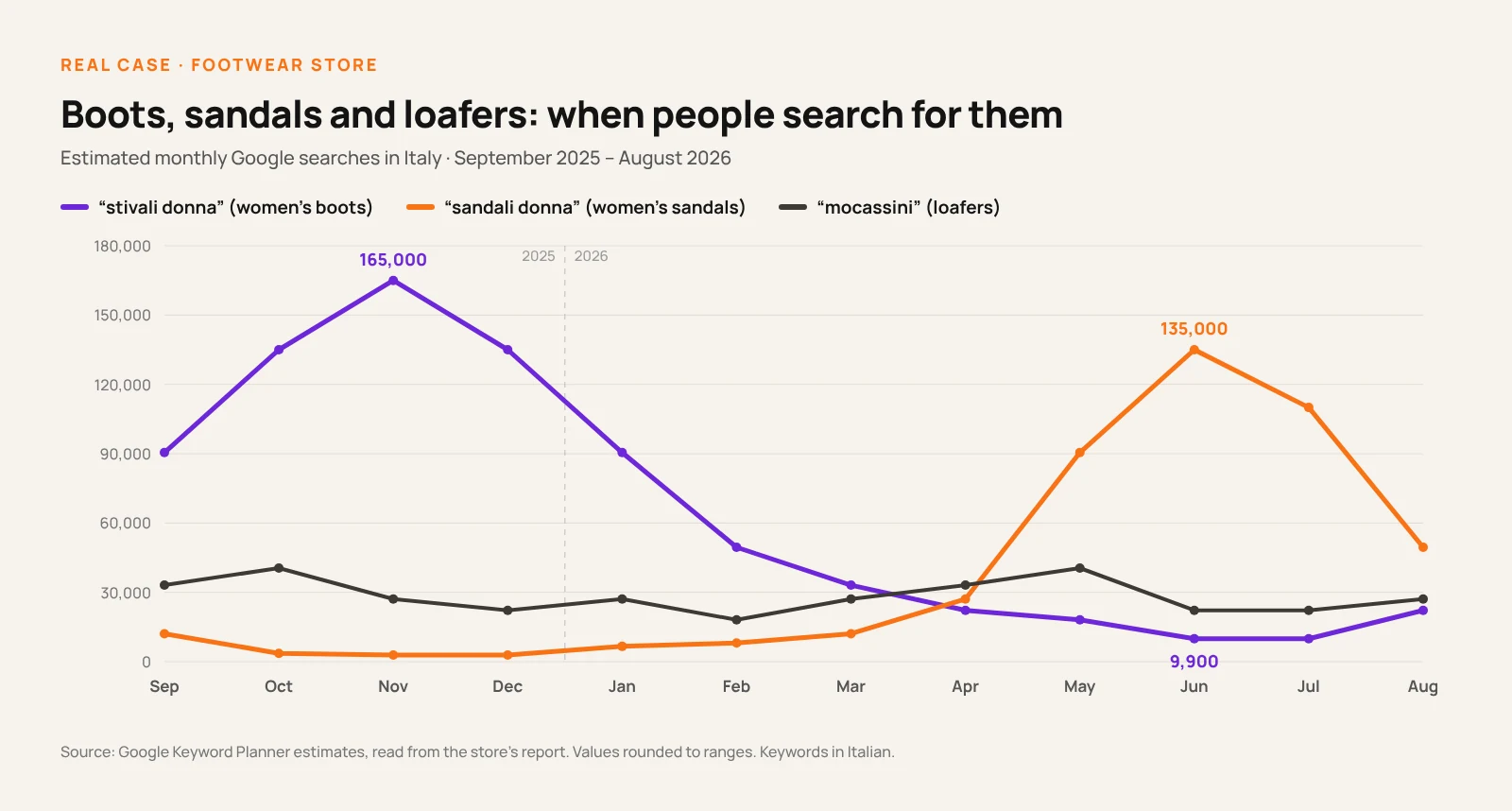
- "Stivali donna" (women's boots) goes from 9,900 searches in June and July to 165,000 in November: about 17 times as many. In September it's already at 90,500.
- "Sandali donna" (women's sandals) follows the opposite path: 135,000 in June, 2,900 in November and December.
- "Mocassini" (loafers) is the in-between-season shoe: it never drops below 18,100 and has two peaks, in October and May.
The practical takeaway: you start talking about boots in September and October, while the curve is rising, not in November when it's at the top and everyone is talking about them. And a store still pushing sandals in its recovery emails in October is talking to very few people.
Two words of caution about these numbers. They're estimates rounded into ranges, useful for the shape of the season more than for the exact value. And Google Trends, often used in their place, doesn't give volumes: it shows an index from 0 to 100 relative to all searches in that period.
The questions people are asking right now
Next to the volumes are the questions that show up in searches. Some come back every month, others pop up out of nowhere.
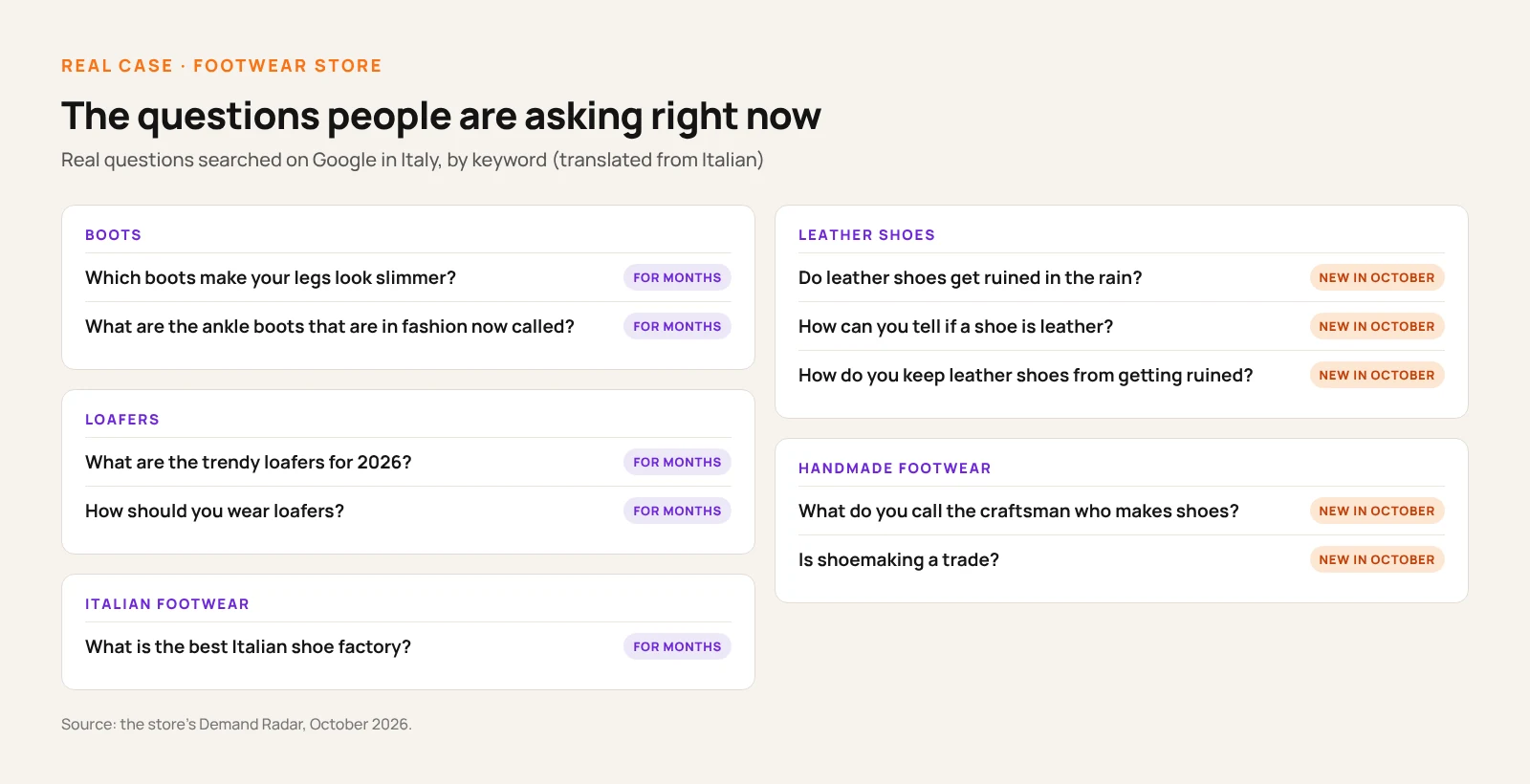
Each one is a ready-made topic. "Do leather shoes get ruined in the rain?" (translated from Italian, like the next one) is an October newsletter on leather care, and also a line on the product page. "Which boots make your legs look slimmer?" is the title of a guide and the answer to an objection no customer would ever write in a review.
From research to messages: emails, ads, product pages
| What you found | Where you put it |
|---|---|
| Objection about size | Size guide on the product page; checkout recovery email with an invitation to ask for sizing advice |
| Desire for comfort | Subject line and first line of emails; first image of the ad |
| Growing searches (boots from September) | Newsletters and ads brought forward 4-6 weeks ahead of the peak |
| New question (leather and rain) | Service newsletter; product page FAQ |
| The category's language | Words to use and words to avoid in your tone of voice, for whoever writes and for AI |
| People who bought sandals in summer | Email for the switch to the new season |
The last row is an example of a trigger: someone who bought sandals in July is the audience closest to a first pair of closed shoes. We explain how to build those segments in our ecommerce email marketing strategy.
How often to redo it
- Desires, objections, language: every 3-6 months, or when a lot of new reviews come in. They change slowly.
- Searches and questions: every month. The season's curve repeats, but new questions don't, and they're the most useful.
- After a launch or a price change: right away, because the objections change.
The most common mistakes
- Reading only 5-star reviews. They tell you what people like, not what holds them back.
- Copying competitors' sentences. They make you just like them, and they're often promises nobody checks.
- Mistaking volume for intention. 165,000 searches for "stivali donna" (women's boots) aren't 165,000 customers: many are curiosity, comparisons, prices.
- Using Google Trends as if it were volumes. An index of 100 is the highest point of that search, not a number of people.
- Doing the research once and filing it away. The most valuable part, the new questions, goes stale in a month.
- Stopping at the research. It tells you what people care about; which angle makes them buy is what your email results tell you.