You can send marketing emails without consent only to customers, and only under specific conditions: you got the email address through a sale, you write about your own products or services similar to what they bought, and the customer was informed and left free to object, both when the address was collected and in every email. This is the soft opt-in, sometimes called soft spam; everyone else needs consent.
This article explains the general rules and does not replace legal advice on your case.
If you sell in the EU, the rules come from Article 13 of the ePrivacy Directive, which each country has written into its own law, and from the guidelines of the European Data Protection Board (EDPB). Here we turn them into practical choices: who you can contact, how to build the signup form, which filters to put in your flows and what to record. With a real case from a footwear store we work with.
Can I send marketing emails to customers who didn't subscribe to my newsletter?
For marketing emails the general rule is prior consent. Article 13 of Directive 2002/58/EC allows a single exception, designed for people who have already bought. Everything else goes through consent.
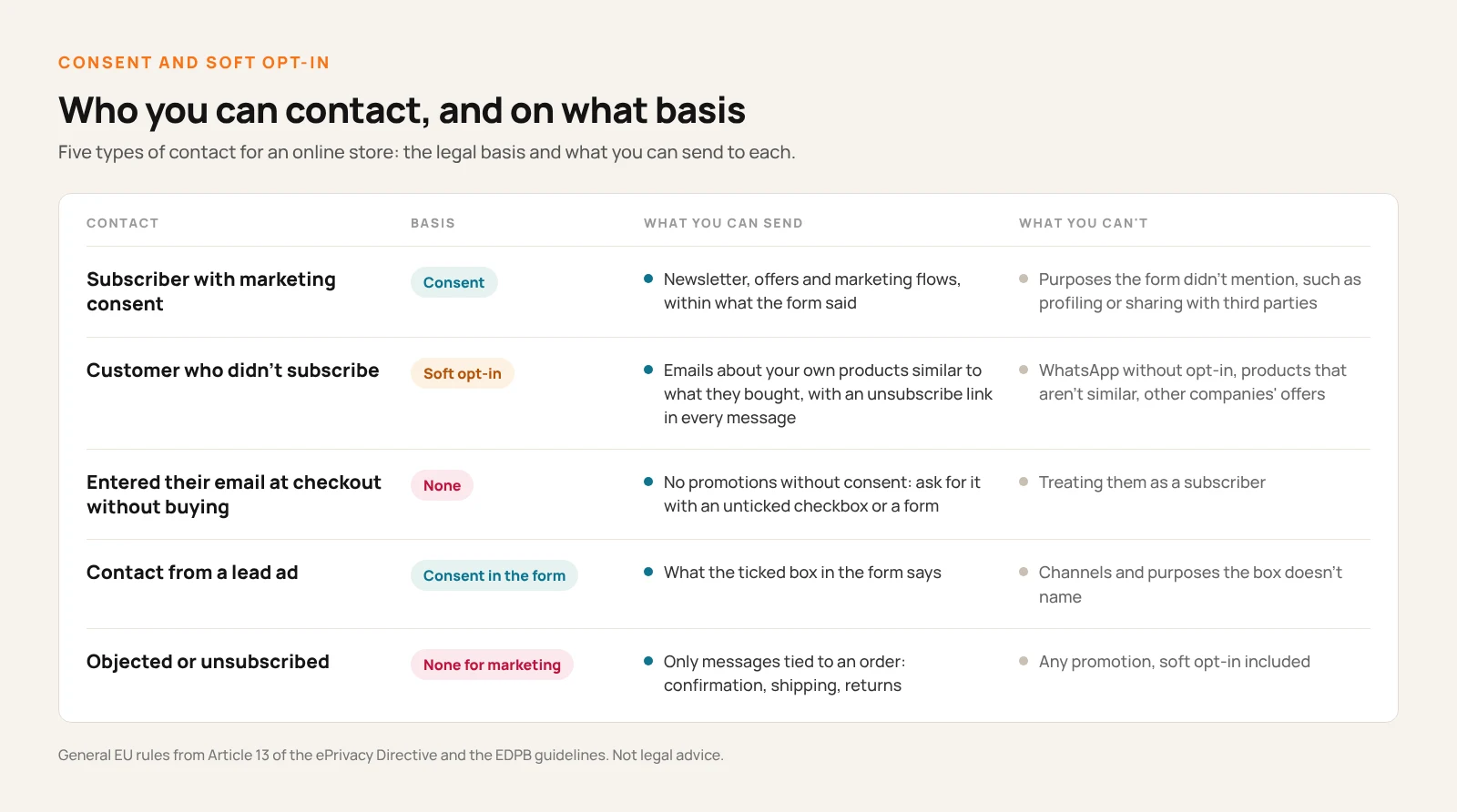
| Who the contact is | Basis for emailing them | What you can send |
|---|---|---|
| Subscriber with marketing consent | Consent | Newsletter, offers, marketing flows, within what the form said |
| Customer who didn't subscribe | Soft opt-in, if every condition is met | Emails about your own products similar to what they bought, with an unsubscribe link in every message |
| Entered their email at checkout without buying | None, without consent | No promotions: ask for consent |
| Contact from a Meta lead ad | The consent in the form | What the ticked box says, nothing more |
| Objected or unsubscribed | None for marketing | Only messages tied to an order: confirmation, shipping, returns |
The abandoned checkout is the case that raises the most questions. We covered it for cart recovery in the article on whether abandoned cart emails are transactional or marketing. What matters here: without a sale the soft opt-in doesn't apply, and the safe choice is not to treat that contact as a subscriber. The Court of Justice of the EU (Case C-654/23, 13 November 2025) read "in the context of the sale" broadly, but it did not rule on abandoned checkouts: for those, the safe choice is still consent.
Outside the EU the rules differ. In the UK, regulation 22(3) of PECR has the same structure but also covers contact details obtained during "negotiations for the sale", a wider wording: check with your adviser how it applies to abandoned checkouts. In the US, CAN-SPAM works on an opt-out basis: no prior consent, but every email needs a working unsubscribe and opt-outs must be honored within 10 business days.

Try AchillesAI for free: it optimizes the copy of your emails continuously and automatically.
Try it for freeThe three conditions of the soft opt-in
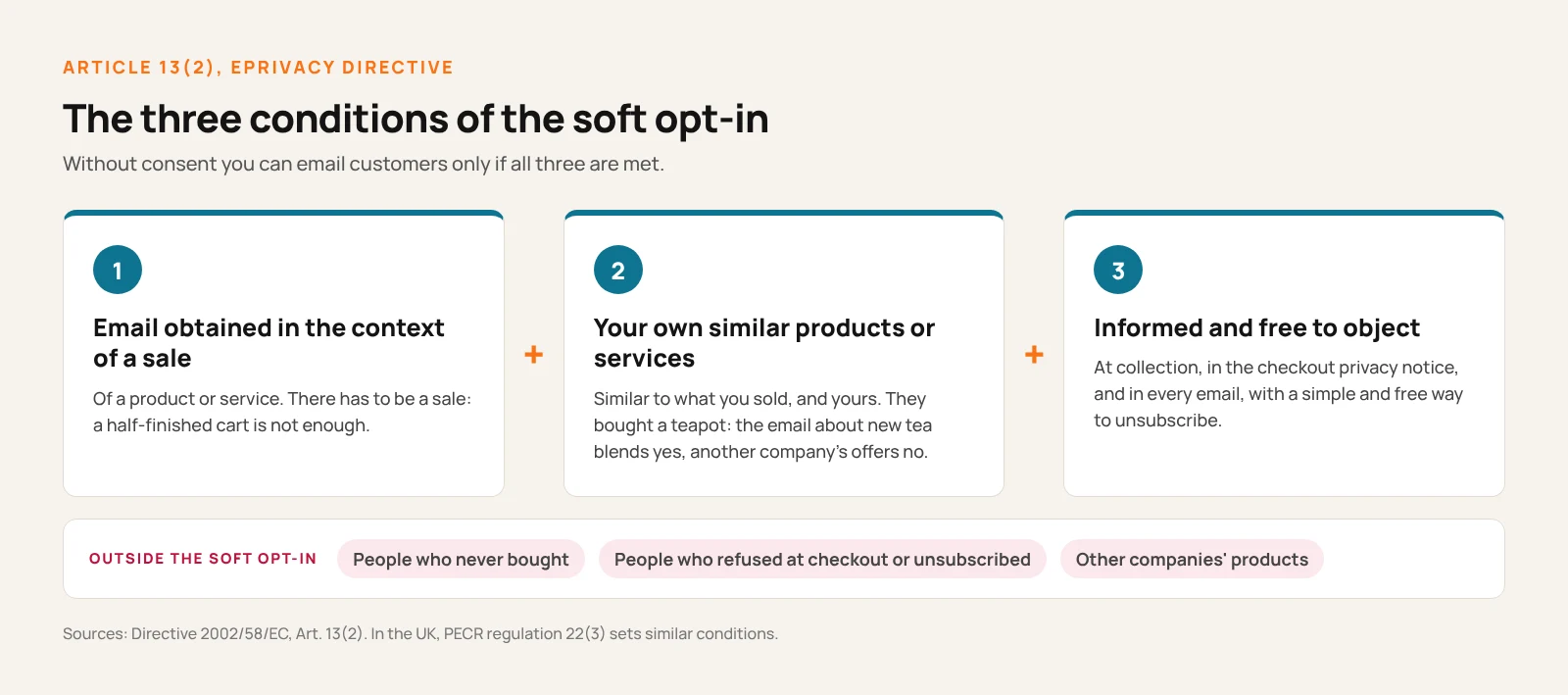
Article 13(2) of the ePrivacy Directive lets you skip consent for direct marketing emails about your own products or services only when all three of these conditions are met.
- The email address was obtained in the context of the sale of a product or service. There has to be a sale: on a cautious reading, a half-finished cart or a quote is not enough.
- You use it for your own similar products or services. Similar to what you sold, and yours. Someone who bought a teapot can get the email about your new tea blends. Another company's offers can't go to them.
- The customer is informed and free to object, at collection and in every message. The privacy notice at checkout has to say so, and every email has to offer a simple, free way to stop receiving them. If the customer refuses at the start or later, the soft opt-in ends.
Two limits to keep in mind. Whether the exception also covers SMS depends on national law, and for WhatsApp Meta requires an explicit opt-in that names your business anyway, as we explain in the guide to cart recovery by SMS and WhatsApp. And being a customer is not enough: if the checkout privacy notice didn't mention marketing emails, the third condition is missing.
Marketing consent and content consent: two purposes
Consent has to be specific. The EDPB says that when processing serves several purposes, people should get a separate opt-in for each one. Its own example is a retailer asking, in a single request, for consent to email marketing and to share details with other group companies: that consent is not valid.
For a newsletter, this means asking what it really contains.
- Every email talks about products or offers, even the one with a guide or a story. There is one purpose, marketing, and one consent is enough.
- A content-only newsletter, with no products, plus separate promotional emails. Those are two purposes: people must be able to choose one, the other or both.
- You profile people or share their data with others. That needs its own consent, never bundled into the newsletter one.
Checkbox or a sentence under the button?
This is where caution pays, because the answer depends on the form. These points are settled:
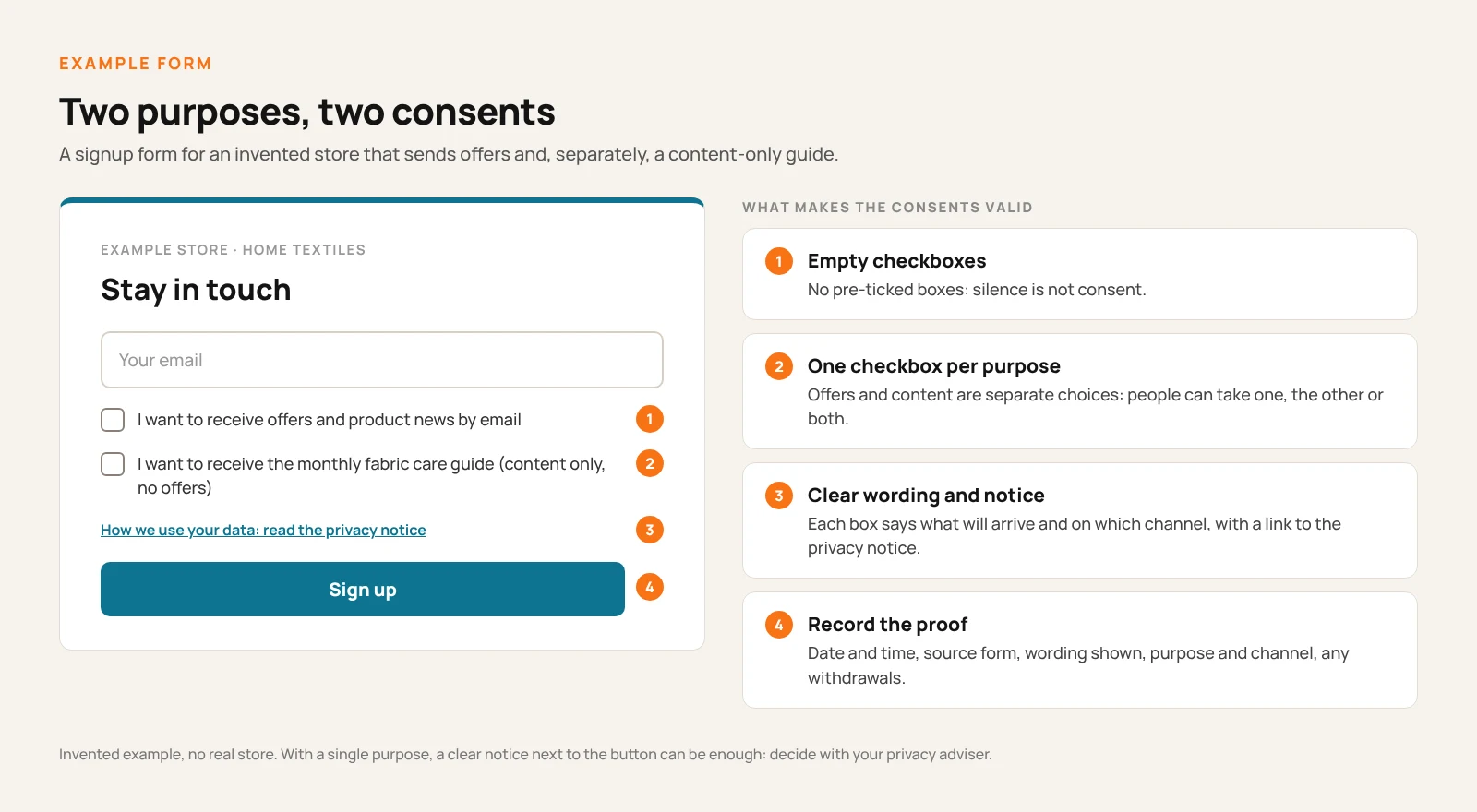
- Never pre-ticked boxes. The EDPB says so plainly: silence or inactivity is not consent.
- Consent can't be a condition. If people have to accept marketing to buy or to register, consent is not freely given.
- Consent isn't given with the same click that completes a purchase. The EDPB rules this out: at checkout, the "Pay" button can't double as a newsletter signup. There you need a separate, optional checkbox.
- More purposes, more checkboxes. When you ask for two different consents, each gets its own empty checkbox, and the form works even if neither is ticked.
That leaves the single-purpose form, such as a popup that only signs people up for offers. The GDPR asks for a statement or a clear affirmative action, and the EDPB leaves you free to design the mechanism as long as there is no ambiguity. A clear notice next to the button, saying what people will receive, can be enough. If the form also collects something else, or if you're unsure, a separate checkbox is the safer choice. Make this call with your store's privacy adviser.
The case: how a real popup keeps email and WhatsApp apart
The footwear store we work with sells handmade, high-end women's shoes on Shopify with Klaviyo. Its signup popup, described in the article on the ecommerce signup popup, keeps the two channels separate.
- Email. Name and email in a step dedicated to signing up, with one line about consent under the button.
- WhatsApp. A later, optional step with full consent wording: informational and marketing messages, including cart reminders; consent is not a condition of purchase; reply STOP to opt out. People who don't want to share their number skip the step and stay subscribed by email.
Separate consents didn't empty the channel. In the last 30 days (September 10 to October 10, 2026), 63% of the people who left their email also left their WhatsApp number.
One more figure teaches something. From November 2025 to October 10, 2026 the WhatsApp list recorded 5,910 sign-ups, but only 4,541 new SMS/WhatsApp messaging consents were recorded, about 3 in 4. The reason can't be worked out from the system data. The lesson is clear, though: being on a list is not the same as having recorded consent.
Exclusions in your flows: who gets in and who doesn't
The rules don't help much if automated flows email everyone. In every marketing flow, the entry condition has to check consent for that channel, not list membership.
| Flow | Who can enter |
|---|---|
| Welcome, newsletter, campaigns | Only people with email marketing consent |
| Abandoned cart and abandoned checkout | Only people with email consent; customers also under the soft opt-in, for similar products |
| Post-purchase: confirmation, shipping, returns | All customers: these messages are tied to the order |
| Post-purchase: suggestions of other products | People with consent, and customers under the soft opt-in only for similar products |
| WhatsApp reminders and offers | Only people with WhatsApp consent |
At the footwear store, on October 10, 2026, the account had 35,390 profiles and 26,963 of them could receive marketing emails, 76%. The gap includes people who unsubscribed (7,314 profiles), addresses that bounce (767) and people with no recorded consent. The groups overlap, so they shouldn't be added up. These are people the store knows, but campaigns must not reach them.
Recording consent: date, time, wording, source
You have to be able to prove consent. The EDPB guidelines ask you to show how and when it was given and what information the person had at that moment. For each contact, store:
- date and time of consent;
- the source: form, page, lead ad or checkout checkbox;
- the exact wording shown next to the button or checkbox, with the version of the privacy notice;
- the purpose and channel: email, WhatsApp, SMS;
- withdrawals, with their date.
If you change the form wording, keep the previous version too: consent collected a year ago has to be read with the words of a year ago.
The most common mistakes
- Assuming being a customer is enough. Without a notice at checkout and similar products, the soft opt-in doesn't hold.
- Treating an abandoned checkout as a signup. No sale and no consent means no promotions.
- Using a list as proof of consent. Lists also contain people who unsubscribed or came in through an import.
- One checkbox for everything. Marketing, profiling and sharing with third parties need separate choices.
- Making consent mandatory to buy or register. Marketing consent has to stay optional.
- Email consent doesn't cover WhatsApp. Every channel has to be named in the consent.