There's no perfect copy for everyone: there's the right copy for your audience at a specific moment, and it comes from the inputs you give whoever writes it, a person or AI. Seven inputs matter: who reads it, what they want, what holds them back, the words to use and avoid, the angle that has already made them buy, the moment and the proof. You already have them in your data. We'll walk through it with the numbers of a footwear store we work with.
Is there a perfect copy for your audience?
There's the right copy, and it changes on two levels.
It changes from angle to angle, and from store to store. In the footwear store's cart recovery emails, across its full history, emails using the novelty angle record 23 orders from 3,125, 0.74%. Belonging stops at 0.16% across 6,898 sends. Between the best and the worst angle, in the same store and with the same customers, the order rate is more than four times higher. In another store the ranking could be the opposite.
It changes from person to person. In the same store, one customer ignored emails built on social proof, urgency and discount, and bought after the one built on novelty. It's a single case, but it shows the mechanism: the segment tells you who to write to, not what persuades each person. We tell the whole story in the article on email segmentation.
So the useful question isn't "how do I write the perfect copy?" but "what do I need to know before I write?". A good copywriter with a generic brief writes generic copy. Any copywriter, or an AI, with the right inputs writes copy that feels written for the person reading it.

Try AchillesAI for free: it optimizes the copy of your emails continuously and automatically.
Try it for freeWhich inputs should you give whoever writes?
| Input | The question | Where you find it | What happens without it |
|---|---|---|---|
| 1. Who reads it | Who is it for, and what have they already done? | Segments, order history, stage in the journey | The same copy for someone who bought yesterday and someone who never bought |
| 2. What they want | What do they really want from the product? | Positive reviews, Google questions | Generic benefits: "quality", "style", "elegance" |
| 3. What holds them back | Which doubt stops them before buying? | 3- and 4-star reviews, pre-purchase questions | The doubt stays, and so does the cart |
| 4. The words | How do customers talk, how does the brand talk, what is never said? | Reviews, tone of voice guide | Copy any store could have put its name to, or words the brand would never use |
| 5. The angle | Which argument has already made this audience buy? | Email results by angle | Angles picked at random, almost always the discount |
| 6. The moment | Why right now? | Monthly Google searches, calendar, when the message lands | Boots launched after the peak, sandals in October |
| 7. The proof | What backs up what I say? | Real reviews, data, guarantees, return policy | Promises with nothing behind them |
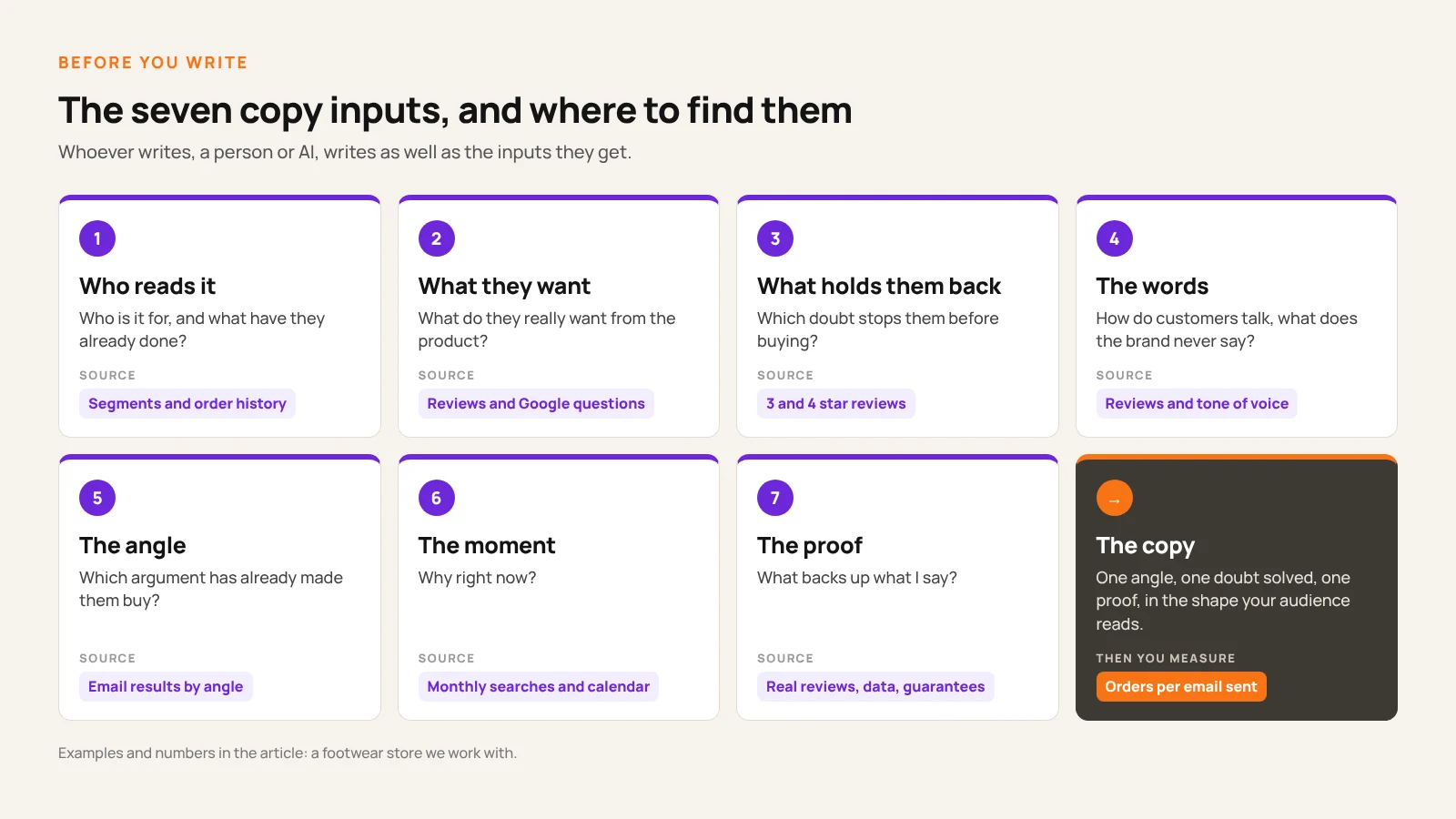
The first four come from market research: reviews, competitor websites and Google searches. The angle comes from your email results. The moment from month-by-month searches and the calendar. The proof from real reviews and your terms of sale.
An input is different from a style instruction. "Make it engaging" tells the writer nothing. "Customers are afraid the shoe won't fit, and this is how they put it" tells them exactly what to solve and with which words.
The same product, with and without inputs
Let's take an ankle boot from the footwear store and write two launch emails. We wrote them for this article. Desire, objection, language and quote come from the store's market research, angle and moment from its data; the chosen audience is an example.
Without inputs. Subject line: "New fall-winter collection: 10% off for you!". Copy: "Discover the new collection: elegance, quality and style for the new season. For a few days only, enjoy 10% off the whole catalog. Don't miss out!"
With the inputs. Subject line: "The new ankle boot is here 👠". Copy: "Just in from the workshop: soft leather and a heel you can wear all day. Not sure about the size? A customer wrote: ‘the leather is soft and wraps the foot well, the insole is slightly contoured’. Tell us the size you usually wear and we'll tell you which one to order."
| Input | Where it comes from | What it became in the copy |
|---|---|---|
| Who reads it | Subscribers who looked at boots and haven't bought yet | No discount: first you remove the doubt |
| Desire | Reviews: real comfort, all day long | "A heel you can wear all day" |
| Objection | Reviews and questions: the fear of ordering the wrong size | The question about size and the offer of advice |
| Words | The category's language: softness, support, craftsmanship | "Soft leather", "workshop" |
| Angle | Novelty, the angle with the highest order rate in the store's recovery emails | "New" and "is here" in the subject line, "Just in" in the opening |
| Moment | Searches for women's boots in Italy rising from September | The launch before the November peak |
| Proof | A real review, quoted without polishing (translated from Italian) | The customer's sentence |
Any shoe store could send the first email. Only this one can send the second, to these customers, this month. And it stays between 35 and 60 words, the range that in this store's recovery emails has a higher order rate than 80-120 words.
Length, subject line and tone: the shape is in the data too
Inputs tell you what to write. The shape has its own data too, and it changes from one audience to another.
- Length. In the footwear store, over the last 90 days, recovery emails of 35-60 words have an order rate of 1.3% across 11,271 sends, those of 80-120 words 1.0% across 6,843. It's consistent with what Nielsen Norman Group's research has shown for years: people skim on the web. In an email, every sentence has to earn its place.
- Subject line. The store's 381 subject lines average 38 characters; 16% have an emoji and only 7% are questions. The style of the subject lines that have already worked with your list is a better starting point than any general rule.
- Tone. From the copy that brought in orders: elegant but direct, one or two emoji at most, never shouted urgency. "OFFER ENDS IN 2 HOURS" clashes with a brand of handmade shoes like this one.
These aren't universal rules: they're this list's rules. You'll find yours in your own email results, read by length, subject line and angle.
From audience to individual person
Audience inputs are enough for a newsletter or an ad. For a message to one person, like a cart recovery email, you can go one level deeper.
- With little history, use the segment. Someone who just subscribed only has the product they looked at: the audience input applies, meaning the angle that works best in the store.
- With history, use the person. What they bought, which angles they've already ignored, when they open, which kind of subject line they seem to prefer. For the customer mentioned above, 12 of her 16 opens in the last 180 days came on short subject lines, under 35 characters: a clue to check, not proof.
- Try several angles, and keep notes. After one order, no angle is "theirs" forever: the next email tries a different one where it hasn't been used yet.
It's the difference between real and fake personalization that we explain in the article on AI in email marketing: "Hi {first_name}" is a field, not copy written for that person.
How to tell if the copy is right
You can't spot the right copy by rereading it. You spot it in the results, read with four precautions.
- Orders, not opens. With Mail Privacy Protection turned on, Apple Mail downloads the images in every email automatically and the open is recorded even if nobody read it. To judge copy, look at clicks and orders per email sent.
- One variable at a time. If you change angle, length and subject line together, you'll never know what worked.
- Samples that hold up. Under 100 sends a number is a hint: the store's report shows social proof at checkout at 7.41% across 27 sends, a figure that one order more or less turns upside down.
- Attributed doesn't mean caused. Some of the orders attributed to email would have come anyway. The real proof is a comparison with a control group that doesn't get the message, over the same period.
The input sheet, to fill in before you write
It works for an email, an ad, a product page or a WhatsApp message. Fill it in before you write the first line, or before you ask AI for copy.
Product or topic: [name, link]
1. Who reads it: [segment and what they've already done: viewed, bought, ignored]
2. What they want: [the desire, in customers' words]
3. What holds them back: [the main objection]
4. Words to use: [3-5 words from customers and the brand]
   Words never to use: [list]
5. Main angle: [only one, chosen from your results]
   Angles to avoid as the main one: [the weak ones in your data]
6. Moment: [why now: season, rising search, event, time it lands]
7. Proof: [real quote, pasted without changes, or a verifiable data point]
Shape: [length in words, subject line style, allowed emoji, tone]
One single action: [buy, discover, ask for advice]
If you write with AI, the sheet becomes the prompt. For newsletters you'll find a ready-made template in the article on newsletter ideas. Two rules always apply: you paste the quote yourself, AI must never invent one; prices, dates and product names get checked before sending.
One last input the sheet doesn't include: how much the reader already knows. Someone who isn't aware of the problem needs different copy from someone comparing two products. It's Eugene Schwartz's idea of awareness levels, and it decides which framework to use to build the copy.
The most common mistakes
- Asking for "catchy copy" without inputs. You get copy that's correct and interchangeable.
- Writing for everyone. A message for someone who bought yesterday and someone who never bought speaks to neither.
- Three angles in the same copy. Novelty, scarcity and discount together cancel each other out.
- Discount as the starting point. In the store in this example it isn't even the angle that sells most (0.51%), and it teaches people to wait.
- Inventing or polishing a review. If a customer notices, you lose more than a sale.
- Copying competitors' sentences. Take the register from competitors, never the sentences.
- Judging copy by opens. They're the least reliable number you have.
- Deciding on 20 sends. A result holds when it repeats on a large sample.