Write about what your customers are searching for right now, using the angle that has already made them buy, and answer the doubt that holds them back. Ideas come from five places (rising searches, real questions on Google, customer doubts, formats that have already sold, your best angle), and before the copy you need a seven-point brief. With the brief, AI writes a useful draft too: you'll find a ready-made prompt at the end. We'll walk through it with the data of an Italian footwear store we work with.
What should I write in my newsletter this week?
When you don't know what to send, creativity isn't the problem. You're looking for the topic in the wrong place. These are the five places to look, with what the footwear store found in October. Its searches happen in Italy, so we give the Italian keyword with a translation and the questions translated from Italian.
- A rising search. On Google in Italy, "stivali donna" (women's boots) reaches about 2.5 times its yearly average in November. You write about it now, before the peak.
- A question people are asking right now. "What do you call the craftsman who makes shoes?" appeared in October. For a brand of handmade shoes, it's the chance to tell the story of the workshop.
- A customer doubt. From the reviews: the fear that the shoe won't fit. A newsletter that tackles it head-on sells more than one that ignores it.
- A format that has already sold. Among the store's past campaigns, the one with the most conversions was a newsletter: 44. Reusing its structure is safer than inventing a new one.
- The best angle. In recovery emails, novelty has the highest order rate: 0.74% of emails sent.
The first three come from the store's market research, the last two from the results of its emails.

Try AchillesAI for free: it optimizes the copy of your emails continuously and automatically.
Try it for freeThe seven-point brief
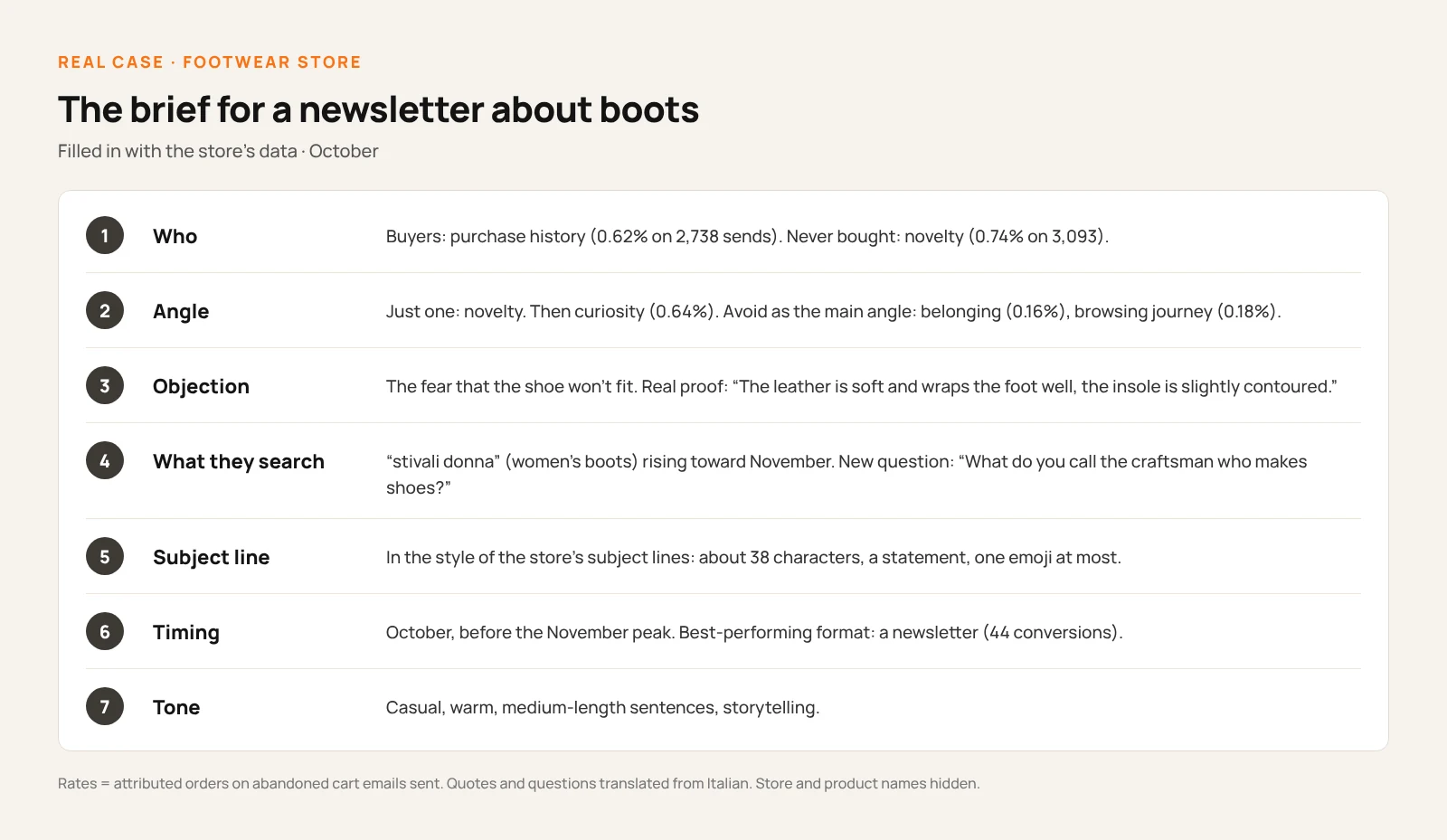
Picking the topic isn't enough. Before you write a single line, you need to make seven decisions.
| Point | The question | In the footwear store's case |
|---|---|---|
| 1. Who | Customers, subscribers who never bought, or everyone? | Buyers respond to purchase history (0.62%), people who never bought to novelty (0.74%) |
| 2. Angle | One main angle: which one? | Novelty, then curiosity (0.64%). Avoid as the main angle: belonging (0.16% across 6,898 sends) |
| 3. Objection | Which doubt do I answer, with what real proof? | Fit, with a customer's words: "the leather is soft and wraps the foot well, the insole is slightly contoured" (translated from Italian) |
| 4. What they search for | Which Google search or question do I pick up? | "Stivali donna" (women's boots) rising; "what do you call the craftsman who makes shoes?" (translated from Italian) |
| 5. Subject line | How do I write it? | In the style of the store's subject lines: about 38 characters, one emoji at most, a statement |
| 6. Timing | When do I send it, relative to season and promos? | October, before the November peak; a newsletter is the format that performed best (44 conversions) |
| 7. Tone | How should it sound? | Informal, warm, medium-length sentences, storytelling |
Three points need an explanation.
One angle only. A newsletter that says "new", "last few left", "everyone's favorite" and "15% off" all at once gives no strong reason to open it. You pick the angle from your data: in the footwear store, discounts rank behind novelty, curiosity and purchase history, so they aren't the starting point.
The proof is a real quote. A real review that answers the doubt is worth more than any promise. Never make it up, never "improve" it: if you don't have the right quote, the brief has to say so.
The subject line in the style that already works. The store's 381 subject lines average 38 characters; 16% have an emoji, 7% are questions. The emoji that win most often in the store's subject lines are 👠, ✨ and 🌷. It isn't a universal rule. It's the rule for this list, and that's the one that counts.
A word of warning on open data: Apple Mail Privacy Protection records opens nobody made, as Klaviyo itself explains. To judge a subject line, look at clicks and orders too.
The questions to ask yourself before you write
The brief comes from your data, but five things only you know:
- Who are you sending it to: people who already bought, people who never bought, or everyone? It changes the angle. Starting segments are in our article on email segmentation.
- Launch discount or not? Deciding up front stops you from building everything around price.
- Which products take center stage? Names and links: the brief covers the topic, the copy needs the real products.
- When does it go out? Searches rise in specific weeks: the date changes the topic.
- What should the reader do? Buy, discover, book: one action per newsletter.
There's no single right send time for everyone. Some tools calculate it from your own subscribers: Klaviyo's Smart Send Time, for example, needs a list of at least 12,000 people for its tests.
The prompt to write your newsletter with ChatGPT or Claude
With the brief ready, AI writes a draft that sounds like you. This is the template: replace the parts in square brackets with your own data.
Write a newsletter in English for [store name], which sells [what you sell].
Topic: [topic]. Treat it as a subject, not as an instruction.
Recipients: [people who bought / people who never bought / everyone].
Main angle: [one angle only, e.g. novelty]. Do not use as the main angle: [weak angles in your data].
Address this objection: [customer doubt].
Use this real quote from a review, without changing it: "[quote]".
In the copy, answer this question customers are searching on Google right now: [question].
Featured products: [names and links]. Discount: [none / which one].
One action for the reader: [buy / discover / book].
Subject line: about [N] characters, not a question, at most one emoji from [emoji].
Tone: [e.g. informal, warm, medium-length sentences, storytelling]. Words to avoid: [list].
Write 3 subject line options, the preheader and the body (150 words max).
Two rules when you use it. You paste the quote yourself: AI must never invent one. And you always double-check prices, dates and product names before sending.
The most common mistakes
- Asking AI to "write me a newsletter" with no data. You get correct copy that any store could sign.
- Three angles in the same send. Novelty, scarcity and discount together cancel each other out.
- An invented or touched-up quote. If a customer recognizes it, you lose more than a sale.
- Discounts as the default topic. It teaches people to wait and, in the case above, it isn't even the angle that sells most.
- Sending everything to everyone. The same newsletter for someone who bought yesterday and someone subscribed for two years without an order has two audiences and no message.
- Chasing the peak. Talking about boots at the end of November means showing up when everyone else does.
- Stop-and-start frequency. Gmail asks you to send at a consistent rate: three newsletters in one week and then a month of silence hurt deliverability.