Choose your copywriting framework based on what the reader already knows: ACC or AIDA for people who don't feel the need yet, PAS for those who feel the problem, FAB for those comparing solutions, 4C for those who know your product, SLAP for those ready to buy. The framework gives the email its shape. The reason someone buys comes from the angle, and you pick the angle from your data. The examples below come from a made-up store selling handmade shoes; the numbers come from an Italian footwear store we work with.
Which copywriting framework should I use for a marketing email?
No framework is better than the others. There's the one that fits that email, and four questions decide it.
- What's the goal? Introduce a new product, solve an annoyance, explain a technical product, close a sale.
- What kind of product is it? A shoe with craftsmanship details to explain calls for FAB. A new idea, like a made-to-measure shoe ordered online, has to be understood first: ACC.
- How much does the reader already know? This question carries the most weight, and it has a precise answer in the five levels of awareness.
- Is there a real deadline? If there is, SLAP. If there isn't, don't make one up.
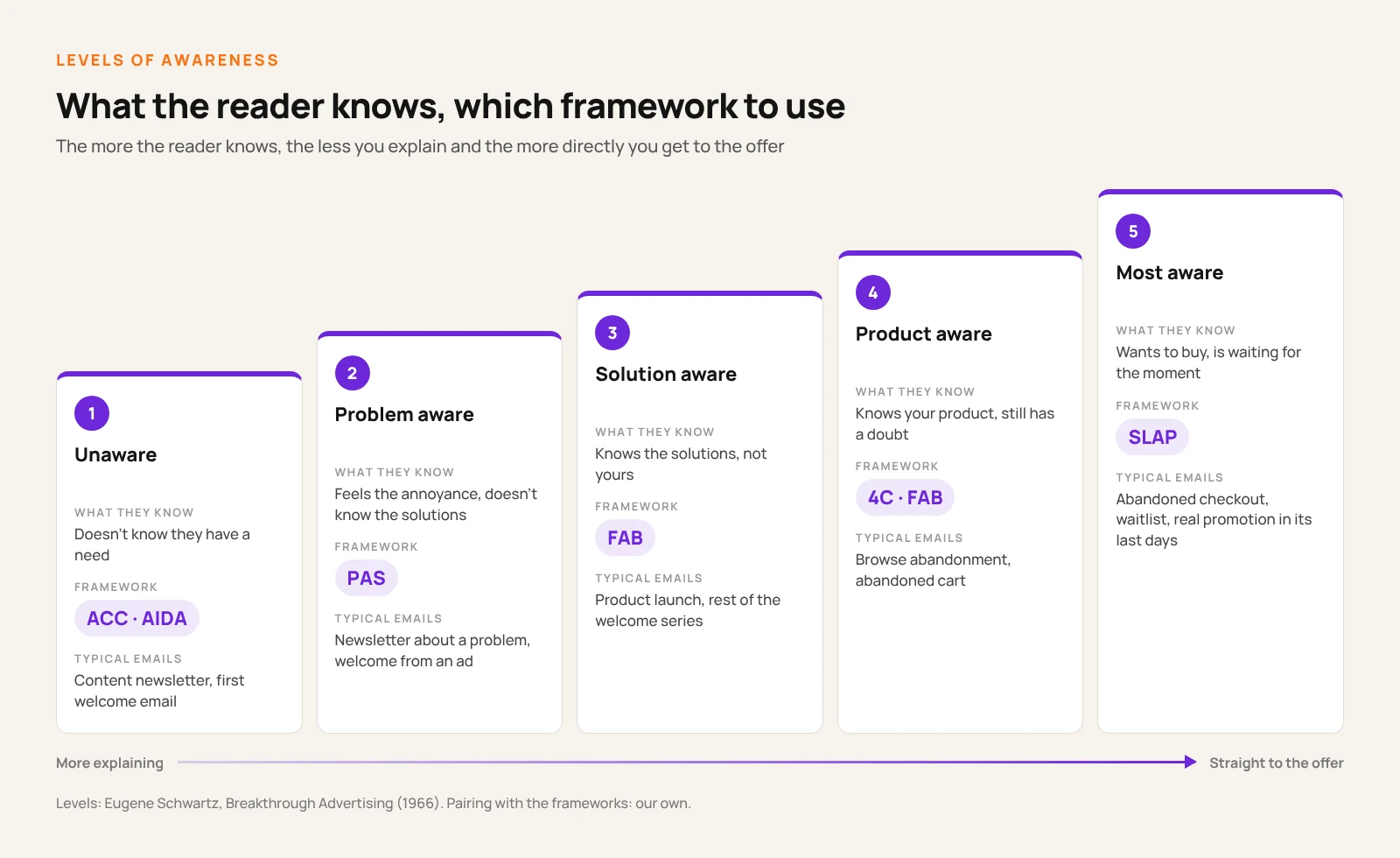
Eugene Schwartz described the levels of awareness in Breakthrough Advertising, published in 1966. The idea is simple: the more the reader knows, the less you need to explain and the more directly you can get to the offer.
| Level | What the reader knows | Recommended framework | Typical ecommerce emails |
|---|---|---|---|
| 1. Unaware | Doesn't know they have a need | ACC, or AIDA with a story | Content newsletter, first welcome email |
| 2. Problem aware | Feels the annoyance, doesn't know the solutions | PAS | Newsletter about a problem, welcome for people who came from an ad about that problem |
| 3. Solution aware | Knows the solutions, not yours | FAB | Product launch, second and third welcome emails |
| 4. Product aware | Knows your product, still has a doubt | 4C, with FAB | Browse abandonment, abandoned cart |
| 5. Most aware | Wants to buy, is waiting for the right moment | SLAP | Abandoned checkout, waitlist, last hours of a real promotion |
AIDA is the most general framework. It works when the list is mixed, as in a launch newsletter sent to everyone.

Try AchillesAI for free: it optimizes the copy of your emails continuously and automatically.
Try it for freeThe six frameworks, with an example email
All the examples are about the same product: a handmade leather loafer with a leather sole. Each one stays between 35 and 60 words, and we'll explain why further down.
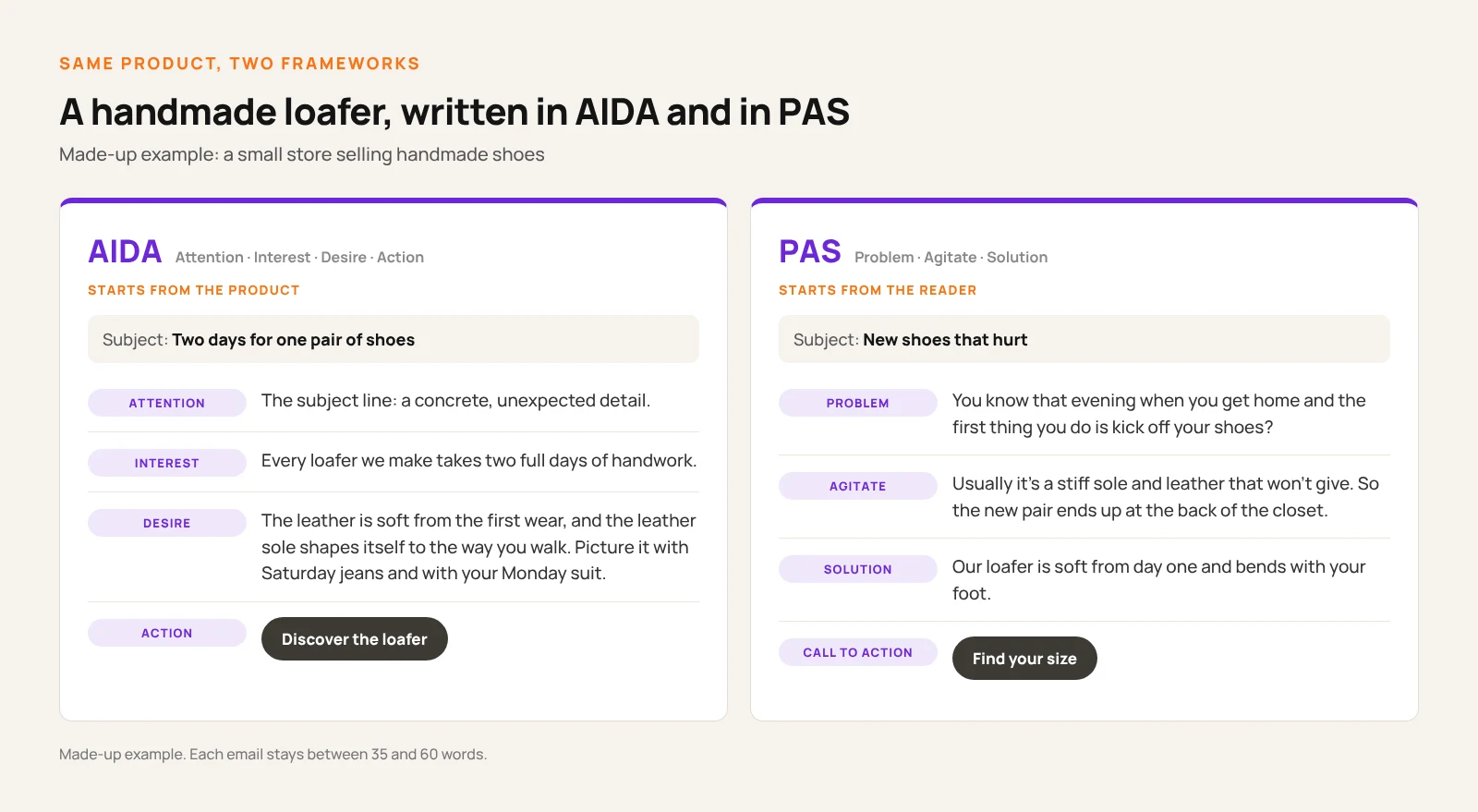
AIDA: attention, interest, desire, action
It's the oldest: it's traced back to E. St. Elmo Lewis, an American advertising man of the late 1800s and early 1900s. You grab attention, build interest, spark desire, ask for an action.
Subject: Two days for one pair of shoes
Every loafer we make takes two full days of handwork. The leather is soft from the first wear, and the leather sole shapes itself to the way you walk. Picture it with Saturday jeans and with your Monday suit. It's the same pair, and it looks right with both.
Discover the loafer
PAS: problem, agitate, solution
You start from a problem the reader recognizes, show its consequences, then offer the solution. It works with people who feel the annoyance but don't know how to fix it. The agitation describes the discomfort as it is: no invented drama.
Subject: New shoes that hurt
You know that evening when you get home and the first thing you do is kick off your shoes? Usually it's a stiff sole and leather that won't give. So the new pair ends up at the back of the closet. Our loafer is soft from day one and bends with your foot.
Find your size
4C: clear, concise, compelling, credible
It's not a sequence but a check: every sentence has to be clear, short, interesting and verifiable. Use it with people who already know the product and have a doubt. There, proof matters more than adjectives.
Subject: The loafer you looked at, in short
Calfskin upper, leather sole stitched by hand. If the size is wrong, exchanges are free for 30 days. Customers who bought it say there's no breaking-in period. Not sure about your size? Just reply to this email: the person who stitched it will answer.
See the loafer again
FAB: features, advantages, benefits
You start from a feature, say what it makes possible, and end with what changes for the person using it. Use it when the reader knows the solutions and needs to understand why yours is different. It's the framework for products with technical details.
Subject: What a hand-stitched sole does
The sole is stitched to the upper, not glued. When it wears out, a cobbler can replace it, and you keep the shoe. So the loafer you buy today lasts for years, and it fits better every year, because the leather takes the shape of your foot.
See how it's made
ACC: awareness, comprehension, conversion
First you bring up a topic, then you explain it, and only at the end do you ask for action. It's the framework for educational emails and for products that need to be understood before they're wanted.
Subject: How to tell if a shoe will last
Look at the sole from the side. If you see stitching, it can be resoled; if it's only glued, the shoe is done once the sole wears through. That's why a stitched shoe costs more on day one and less after a few years. The guide covers three more things to check.
Read the guide
SLAP: stop, look, act, purchase
Short and direct: a reason to stop, something to look at, an action right away. It only works with people who have already decided, and when there's a real reason not to wait. Without a real deadline it becomes fake urgency, and people who spot it stop trusting you.
Subject: Christmas orders close Friday
Every pair is stitched after you order. To deliver by December 24, our workshop takes orders until Friday at 6 p.m. The loafer you left at checkout is still available in your size. Order after Friday and it arrives in January.
Complete your order
The framework can change from one email to the next
Within the same sequence the reader doesn't stand still, and the framework follows. In cart recovery:
- after 1 hour, a 4C reminder, no discount;
- after 24 hours, FAB on the most likely doubt, such as size or durability;
- at 48-72 hours, SLAP, only if there's a real deadline.
You'll find full copy in the abandoned cart email examples.
With people who haven't opened in months, you don't know what level they're at. That's why it pays to switch frameworks at every attempt: the first educational with ACC, the second commercial with FAB on your best-loved product, the third promotional with SLAP and a dedicated offer with a real deadline. No misleading subject lines to squeeze out an open. If no attempt works, stop sending to those contacts: writing to people who don't open drags down delivery for all your emails, as we explain in why emails go to spam.
The framework gives the shape, the angle gives the reason
The framework decides the order of the sentences. It doesn't decide why someone should buy: that's the job of the angle, the lever the message pulls. Novelty, curiosity, discount, social proof, urgency, purchase history. The same PAS can rest on novelty or on a discount, and the results change.
The footwear store we work with sells premium handmade women's shoes. Each cart recovery email uses a few angles, and for each one we count the attributed orders against emails sent. Across the full history:
- Novelty: 0.74%, 23 orders from 3,128 emails.
- Purchase history (a link to what the customer already bought): 0.65%, 18 from 2,779.
- Curiosity: 0.64%, 23 from 3,616.
- Discount: 0.51%, 30 from 5,908.
- Belonging to a community: 0.16%, 11 from 6,901, even though it's among the most used angles.
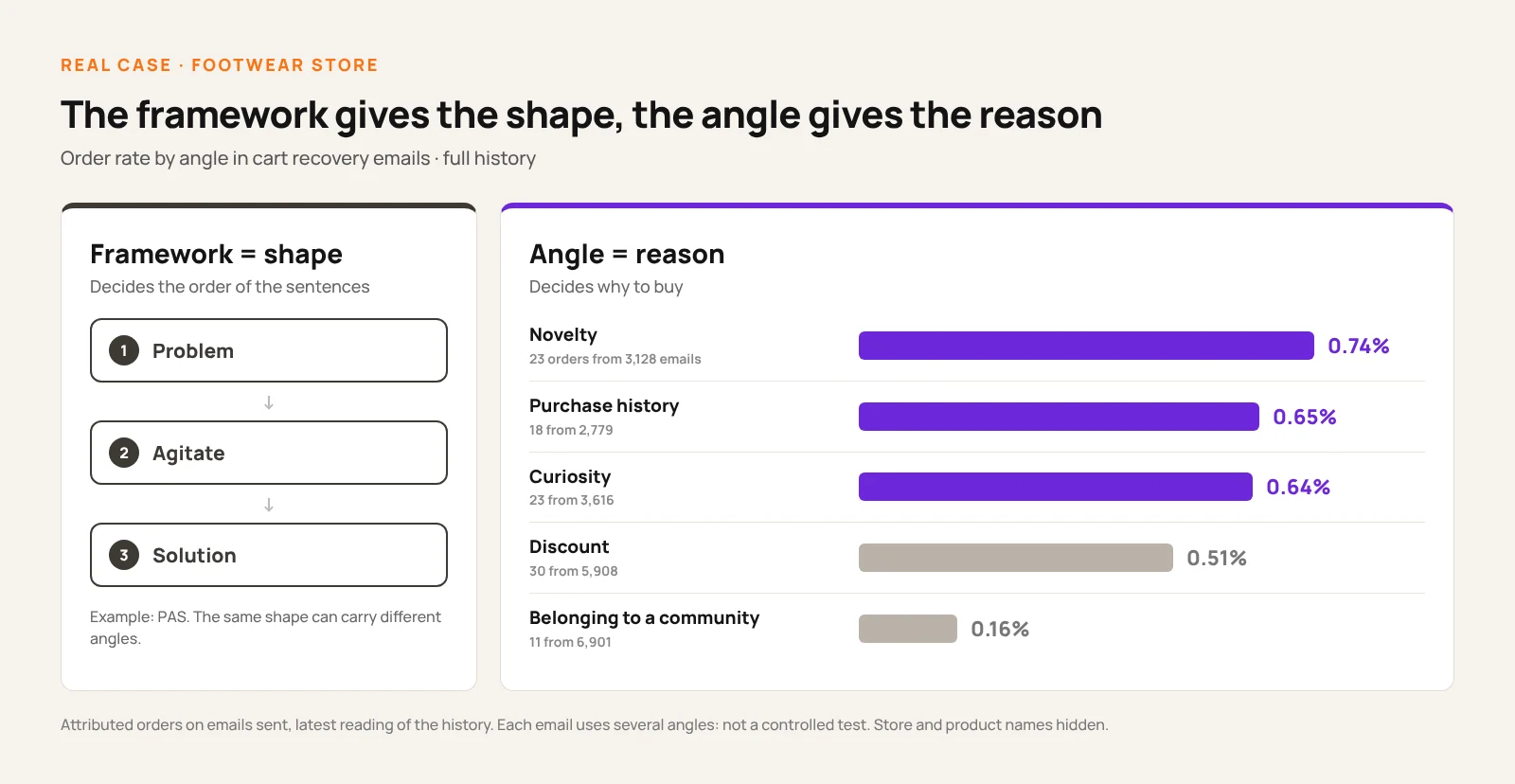
The history grows with every send, so rates move by a few hundredths between readings. In earlier readings, in our articles on email and Meta Ads and on newsletter ideas, purchase history was at 0.61-0.62%, below curiosity; here we report the latest reading. The order between the two changes, but novelty, purchase history and curiosity stay above discounts.
Length matters too. In the last 90 days, emails of 35-60 words have a rate of 1.3% across 11,271 sends, those of 80-120 words 1.0% across 6,843. That's why the examples above stay in that range: each step of the framework fits in one or two sentences.
The limits: this is one store's data, each email uses several angles at once, and it isn't a controlled test.
In practice, you pick the framework from the awareness level and the angle from your data. For people who already bought: FAB with purchase history, "it pairs with the shoes you already own". For people who looked at a style that just arrived: 4C with novelty. How to put framework and angle into a brief is covered in ecommerce newsletter ideas.
The most common mistakes
- Always using the same framework. People at checkout don't need educating, and people who just subscribed aren't ready for SLAP.
- Overdoing the agitation in PAS. An inflated problem or a made-up fear costs you trust.
- SLAP with fake deadlines. A countdown that resets every day teaches people to stop believing you.
- Stopping at features in FAB. "Stitched sole" says nothing until you get to "you'll wear it for years".
- Thinking the framework is enough. Without an angle chosen from your data, it's a correct shape with no reason to buy.