There is no universal best day or time to send a newsletter: you find it in your store's data, by looking at when clicks and orders arrive, not opens. Benchmarks are averages of lists that aren't yours, and they almost always count opens that Apple Mail records on its own. We'll show it with 90 days of data from an Italian footwear store we work with, plus a method to test your send time properly.
What is the best day and time to send a newsletter?
The short answer: whenever your subscribers click and buy, and you only find out by testing. "Tuesday at 10 a.m." rankings come from millions of emails across different industries and time zones, sent by people who had already picked a time. So they describe the habits of senders more than those of readers.
Before you look at an hourly chart, you need to know what each number measures.
| What you look at | What it tells you | The trap |
|---|---|---|
| Opens by hour | When the email gets downloaded | Apple Mail records automatic opens; the spike follows the send time |
| Clicks by hour | When people read and get interested | Some clicks come from security filters, not people |
| Orders by hour (whole store) | When customers have the time and the mood to buy | Mixes email, ads and direct traffic |
| Orders attributed to the campaign, after 3-5 days | How much that send sold | Small samples: a few orders of difference is noise |

Try AchillesAI for free: it optimizes the copy of your emails continuously and automatically.
Try it for freeWhy opens lie about timing
Apple Mail. With Mail Privacy Protection on, Apple's app preloads the images of every email, whether the person opens it or not. The platform sees the tracking pixel load and records an open. Klaviyo flags these opens with a dedicated property, but says there's no way to know whether the person then actually read the email. The download doesn't necessarily happen when the email arrives: in the data below, a wave of it shows up late in the evening.
Bot clicks. Inbox providers and security software click links before people do, to check them. Klaviyo identifies them as bot clicks and removes them from campaign reports when the feature is on; in custom reports you exclude them with a filter. In the October campaign from our case, they were 198 click events out of 1,491, or 13.3%.
The upshot: an hourly opens chart is partly a chart of how phones behave. For timing, clicks and orders are what count.
The case: 90 days of data from a footwear store
The store sells handmade women's shoes in the premium segment. Over the year it sends about one campaign a week on average, fewer in summer. We read every open, click and order from July 12 to October 9, 2026, hour by hour: 120,462 opens, 15,934 clicks and 1,434 store orders from any channel. All times are Italian time.
One fact explains almost everything: in the last 12 months, 35 of 42 campaigns went out between 7:45 and 9:00 a.m., and 20 of them at exactly 8:15 a.m.
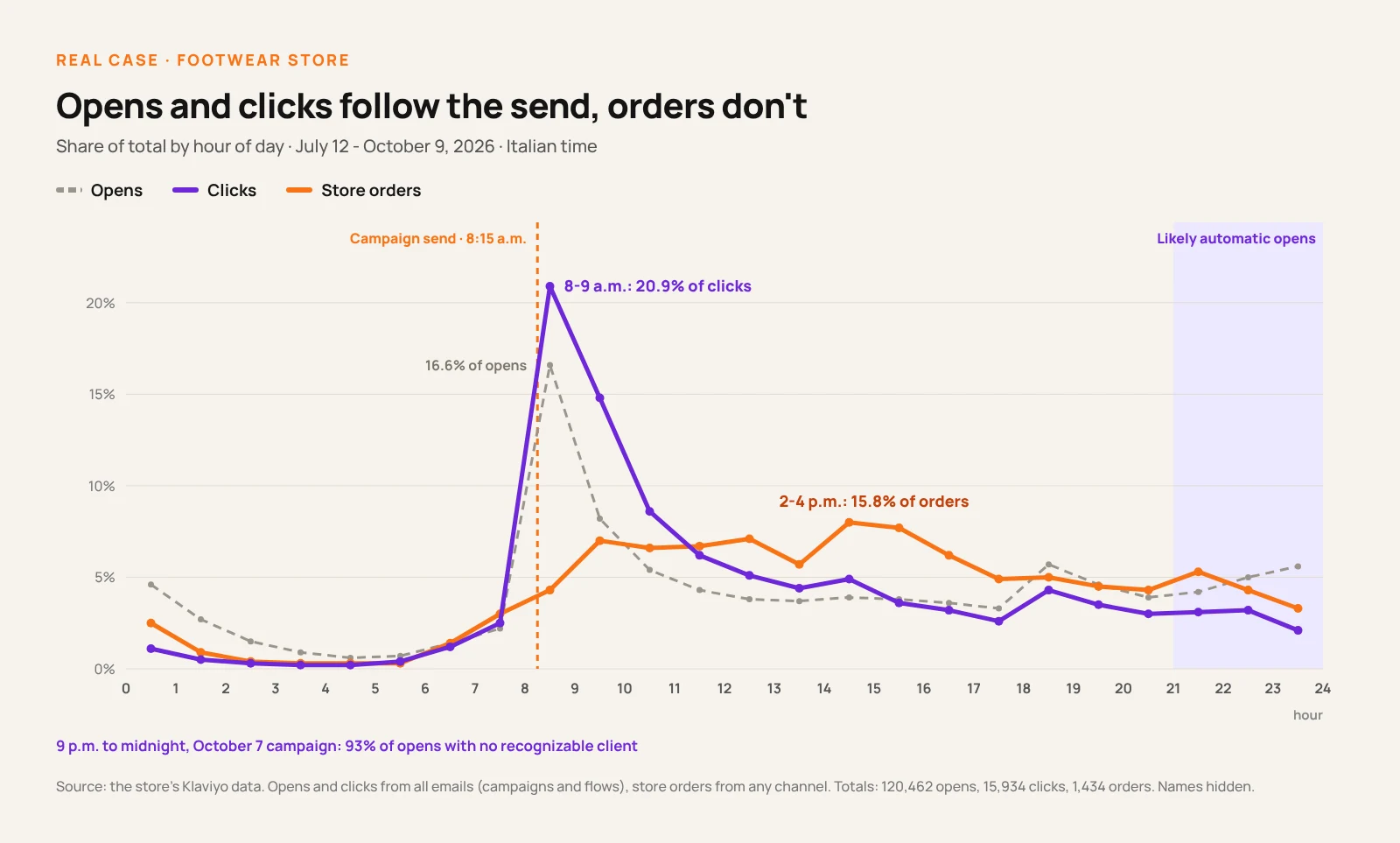
- The 8-10 a.m. spike is the send time. Between 8 and 9 a.m. come 16.6% of opens and 20.9% of clicks, and between 9 and 10 a.m. another 14.8% of clicks. It's not a customer preference: it's when the email lands.
- Orders have a different shape. From 9 a.m. to 5 p.m. come 55% of orders, peaking between 2 and 4 p.m. (15.8%). In the evening, from 6 to 11 p.m., 23%.
- The evening wave is almost all automatic. Between 10 p.m. and midnight come 10.6% of opens but only 5.4% of clicks. In the October 7 campaign, between 9 p.m. and midnight, 93% of opens had no recognizable client (1,304 out of 1,396), the typical sign of Apple's proxy, and there were only 59 clicks in those three hours.
The same goes for days. In these 90 days, Wednesday has 31.2% of opens because four of the seven campaigns went out on a Wednesday. Saturday, which gets few emails (7.5% of opens), brings in 14.6% of orders: as much as Thursday and almost as much as Friday.
After the send: clicks come right away, orders don't
We followed two new-arrivals campaigns hour by hour: one on Wednesday, October 7, 2026, sent at 8:15 a.m., and one on Friday, May 8, 2026, sent at 8:30 a.m.
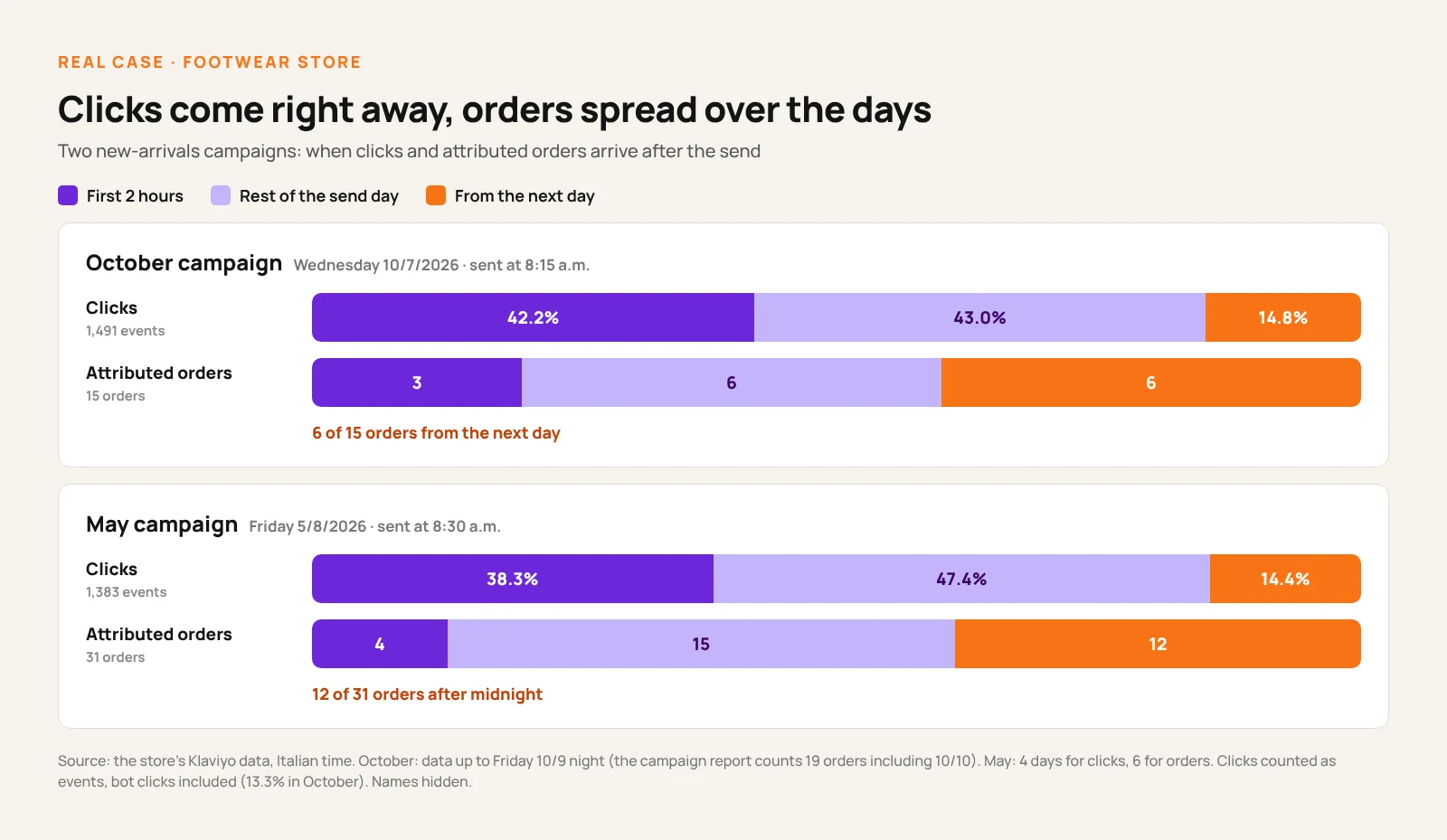
About four clicks in ten arrive within the first two hours: 42.2% in October, 38.3% in May. Orders, on the other hand, spread out. In May only 4 of the 31 attributed orders came in the first two hours, and 12 came after midnight. In October, 6 of 15 orders came from the next day on.
People who click in the morning often browse and come back later, when they have time. Judging a send time on the first hour means measuring the wrong thing. Two campaigns don't describe every customer, but they show what not to look at.
Black Friday morning vs evening: why it proves nothing
In November 2025, the first Black Friday email went out twice on Sunday the 23rd: at 8:45 a.m. and at 9:00 p.m.
| Send | Click rate | Orders | Attributed revenue |
|---|---|---|---|
| Morning, 8:45 a.m. | 1.10% | 10 | €1,779 |
| Evening, 9:00 p.m. | 3.30% | 18 | €4,468 |
The evening send brought 2.5 times the revenue. It looks like a clear win, but it isn't a test. The evening was a second send to the whole audience: people who had already received the morning email got it again, and some of the evening orders may come from that double contact. A fair comparison splits the list at random before sending.
The comparison by time slot over 12 months is skewed too. The few emails sent in the late morning or in the evening were mostly announcements of social media livestreams, which sell little at any hour. The content makes the difference, not the time.
How to test your send time properly
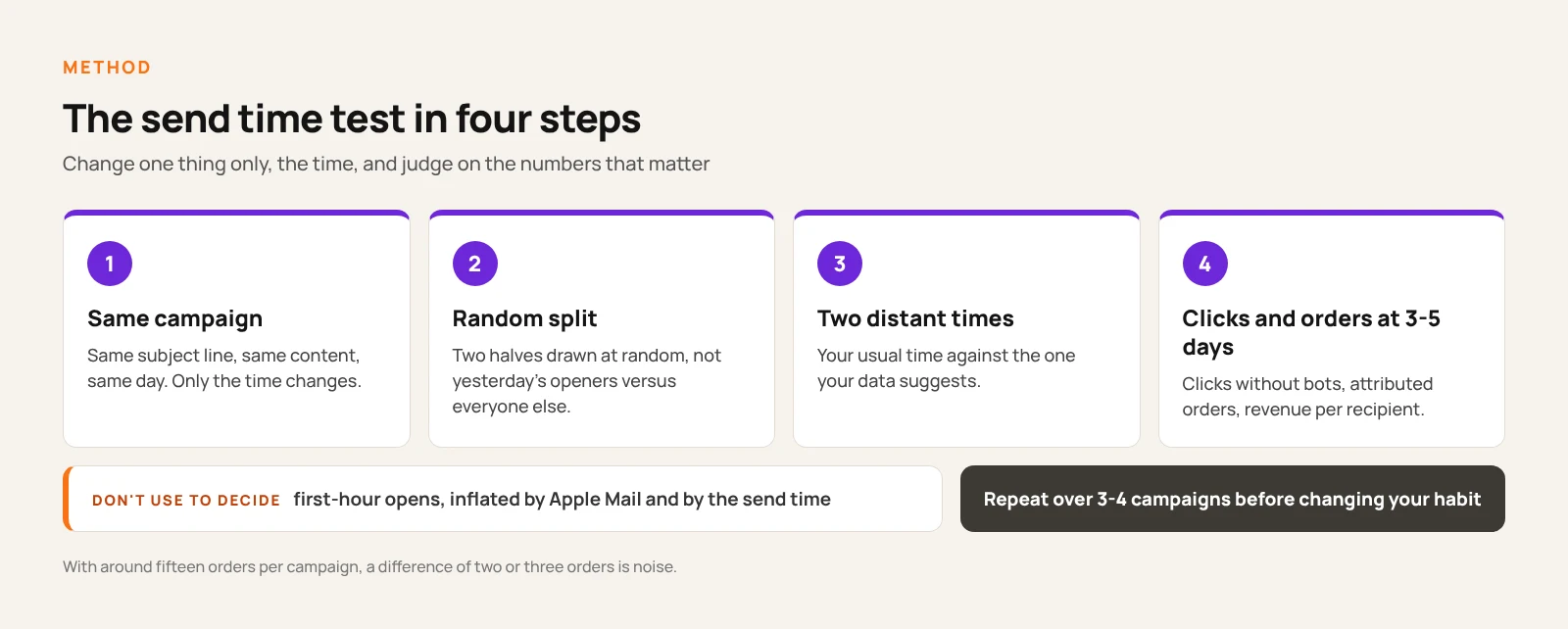
- Same campaign, same content. Change only the time. If you also change the subject line, you no longer know what made the difference.
- List split at random into two. Not "who opened yesterday" versus everyone else: two halves drawn at random. The store in our case sends to about 23,000 people at a time, more than enough for two halves. In 12 months it never ran a test.
- Two distant send times. Your usual time against one your data suggests. Here it would make sense to test 8:15 a.m. against an early afternoon send, close to the order peak.
- Clicks and orders after 3-5 days. Look at clicks without bots, attributed orders and revenue per recipient. First-hour opens are no use.
One test isn't enough. The store's median campaign brings 15 orders: with numbers like these, a difference of two or three orders is noise. Repeat the comparison over 3-4 campaigns of different types before you change your habit.
There are also automatic tools. Klaviyo's Smart Send Time sends at randomly assigned times across 24 hours, then narrows the window. Its tests require a list of at least 12,000 recipients, and Klaviyo advises against using it for flash sales and deadlines, because each person gets the email at a different time. Its chart shows open rate by hour: with Apple Mail in the mix, read it together with clicks and orders.
Send time moves the needle a little, but less than what you write and how you build it. If clicks are low at every hour, the problem is the message: start from our guides on newsletter ideas and on the newsletter layout that gets clicks.
The most common mistakes
- Copying the time from a ranking. It describes the habits of senders, not of your customers.
- Reading the first-hour spike as a preference. It's the send time showing up in the chart.
- Counting bot clicks. In one campaign from our case they were more than one in ten.
- Declaring a winner after a double send. Without a randomly split list, the comparison doesn't hold.
- Deciding on a single test. With around fifteen orders per campaign, you need to repeat it.